How to Choose the Right Mukut for Laddu Gopal — A Complete Guide for Kanha Ji
A complete guide to choosing the right mukut for Laddu Gopal and Kanha Ji — sizing, styles, metal tones, mor pankh significance, stability, and how to match a mukut with different poshak types and occasions.
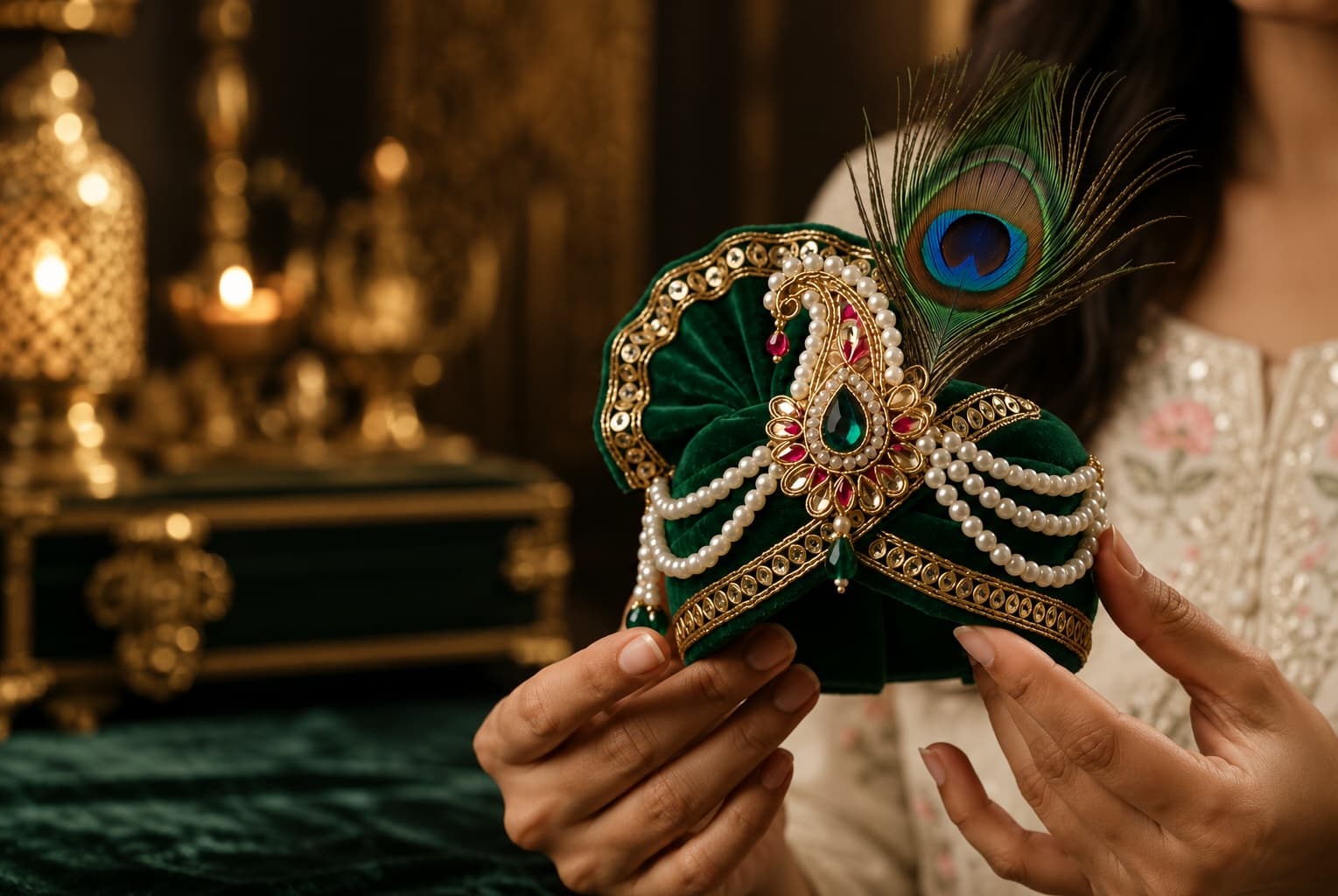 How to Choose the Right Mukut for Laddu Gopal — A Complete Guide for Kanha Ji
Of all the shringar elements in a home mandir, the mukut is the one that most changes how Kanha Ji is perceived.
Not because it is the most expensive. Not because it is the most elaborate. But because of where it sits, at the highest point, visible from across the room, and because of what it represents. The poshak dresses Kanha Ji. The mukut makes Him King.
This is why a mukut that tilts, or sits too high, or looks too small for the poshak beneath it, or is made in the wrong metal tone, creates a dissonance that affects the entire darshan, even when everything else is beautifully done.
Choosing the right mukut for Laddu Gopal or Kanha Ji is a more considered decision than most devotees realize when they buy their first one. This guide covers everything that matters, sizing, style, material, metal tone, mor pankh significance, stability, and how to match the mukut to the poshak and the occasion.
This guide reflects mukut selection practices observed in traditional Vrindavan and Mathura temples, as well as the preferences expressed by devout households across North India (including Delhi, UP, and Rajasthan) who maintain daily shringar routines for Kanha Ji. Whether you are shopping in local markets or looking to buy the best Laddu Gopal mukut online in India, this guide covers everything you need to know. Last updated August 2026.
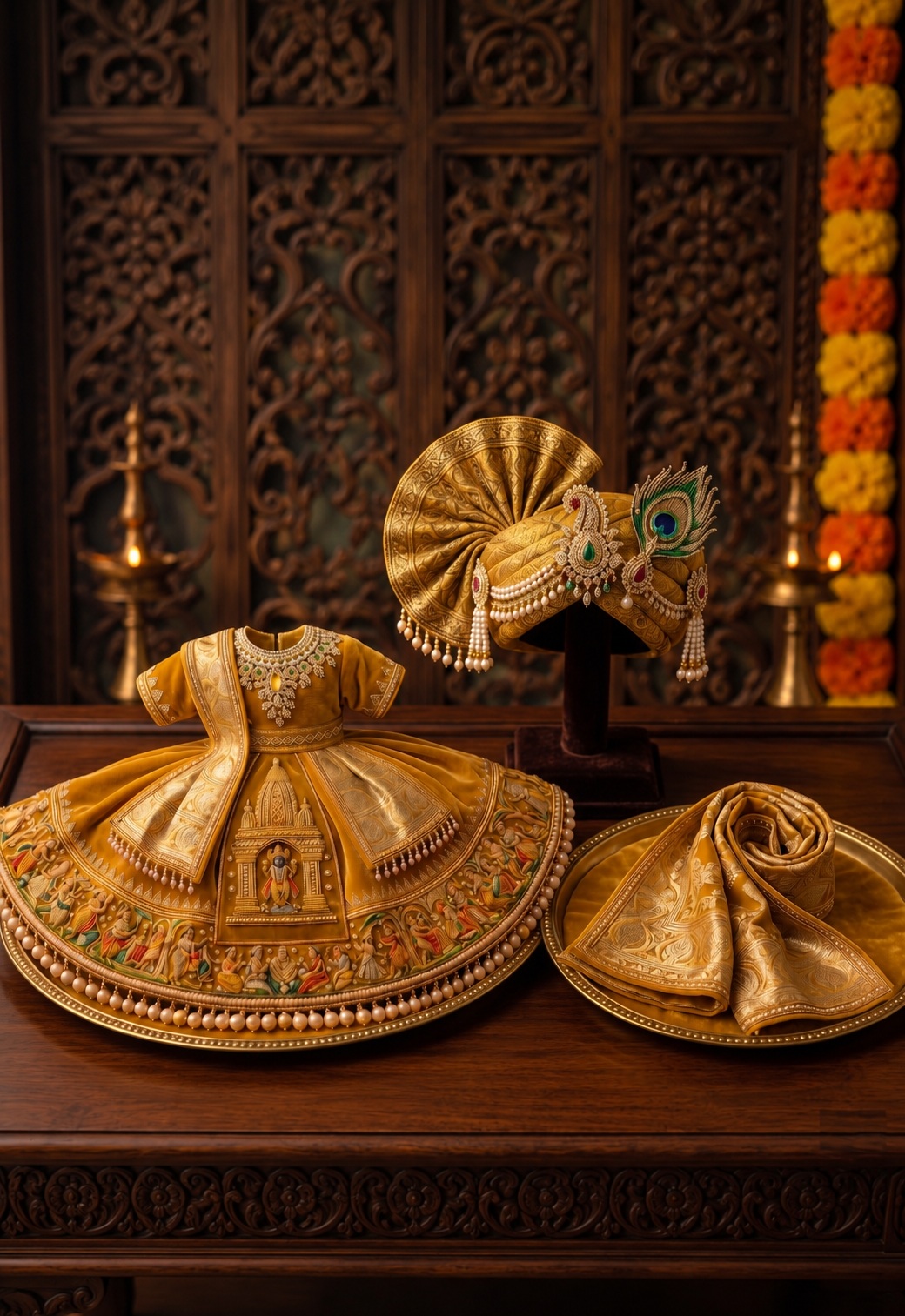
What is a mukut for Laddu Gopal? A mukut is the crown placed on Kanha Ji's head as the final and most regal element of shringar. Unlike poshak, which dresses the body, the mukut establishes the divine royal presence. For Laddu Gopal and Kanha Ji, the mukut typically sits above the head and must be sized, weighted, and proportioned to the specific figure, a mukut that is too large, too small, or the wrong metal tone affects the entire darshan.
Quick Reference, Mukut Selection
- Size: should sit stable without tilting, match to head diameter, not height
- Metal tone: match to poshak embellishment and jewellery
- Style: gold stone-work for most occasions, mor pankh for devotional significance
- For heavy Janmashtami poshak: choose a more substantial mukut
- For daily shringar: a lighter, simpler mukut is more appropriate
- Replace when: loose, tarnished, bent, or visually mismatched with updated poshak
Why the Mukut Matters More Than Most People Think
Many devotees buy a mukut almost as an afterthought, after the poshak is chosen, after the jewellery is in place, as the final item on the list.
The result, very often, is a beautiful Kanha Ji poshak and jewellery set crowned by a mukut that does not quite belong. Either it sits too loosely and tilts with every slight movement. Or it is too small and looks like an accessory rather than a crown. Or it is in a different metal tone from the jewellery, creating visual inconsistency at the most prominent point of the shringar.
The mukut deserves the same quality of attention as the poshak. In some ways, it deserves more, because while a beautiful poshak can carry a moderately chosen mukut, even the most elaborate handmade Kanha Ji poshak is diminished by a mukut that does not fit, does not belong, or does not hold its position.
"The poshak dresses Kanha Ji. The mukut makes Him King. Both deserve the same quality of thought."
When devotees gently place the mukut on Kanha Ji after completing the poshak and jewellery, it often marks the final moment of shringar. Many families pause for a few seconds before stepping back for the first darshan, because it is only then, when the mukut is in place, that the entire presentation feels complete. That pause is worth understanding. It tells you exactly how much the mukut matters.
Sizing a Mukut for Laddu Gopal, The Most Important Factor
The most common mukut problem is not style, it is sizing. Specifically, choosing a mukut based on the overall height of Laddu Gopal Ji rather than the head diameter.
The correct measurement for mukut sizing is the head circumference, not the idol height.
Two Kanha Ji figures of the same height (say, 4 inches) can have slightly different head shapes depending on the maker and the material. A mukut that sits perfectly on one will tilt on the other.
How to measure:
- Place a soft measuring tape or a thread around the widest point of the head
- Note this circumference in centimeters or inches
- Look for a mukut whose inner band diameter closely matches this measurement
What to do if the mukut tilts: This is a very common issue and has a practical solution. A small roll of cotton wool or soft cotton batting placed inside the mukut band before placing it on the head creates a gentle, invisible padding that stabilizes the mukut without modifying the mukut itself. Many experienced devotees use this technique for any mukut that feels slightly loose.
Size number guidance: Just as Kanha Ji poshak comes in size numbers (3, 4, 5 etc.), many mukut sellers also use size numbers. These correspond to head diameter rather than idol height. If you know your Kanha Ji's poshak size, a mukut in the same number is generally a starting point, but head shape variation means always checking the inner diameter description when ordering online.
For poshak sizing help, our Laddu Gopal poshak size chart covers measurement in detail.
Mukut Styles, Understanding Your Options
Not all mukut are the same shape or purpose. Here are the main styles and when each is appropriate:
Gold Stone-Work Mukut
The most widely used and most versatile style. A gold-tone mukut with inlaid stone work (colored glass or semi-precious stones) suits almost every poshak type and every occasion. This is the right choice for most devotees as their primary mukut, it works for daily shringar, festival occasions, and Janmashtami equally well.
Best with: Yellow pitambar Kanha Ji dress, Banarasi silk poshak, standard jewellery sets
Mor Pankh Mukut (Peacock Feather Crown)
The most theologically significant mukut style for Krishna devotees. The peacock feather, mor pankh, is one of Kanha Ji's most recognizable symbols and appears in nearly every classical depiction of the deity. A mukut featuring a real or beautifully crafted peacock feather carries devotional meaning that transcends aesthetics.
Many devotees choose the mor pankh mukut specifically for Janmashtami and for occasions of particular spiritual significance, not simply because it looks beautiful, but because it connects the shringar to the iconographic identity of Kanha Ji Himself.
Best with: Blue or peacock-green Kanha Ji poshak, handmade Kanha Ji poshak, Janmashtami heavy dress
Kundan Mukut
Kundan work, traditional gold-foil set glass, creates a softer, more antique richness than stone-set styles. A kundan mukut pairs particularly well with Banarasi silk poshak and heavy embroidery dress, where its traditional quality complements the textile's character.
Best with: Handwork dress, Banarasi silk, traditional festival occasions
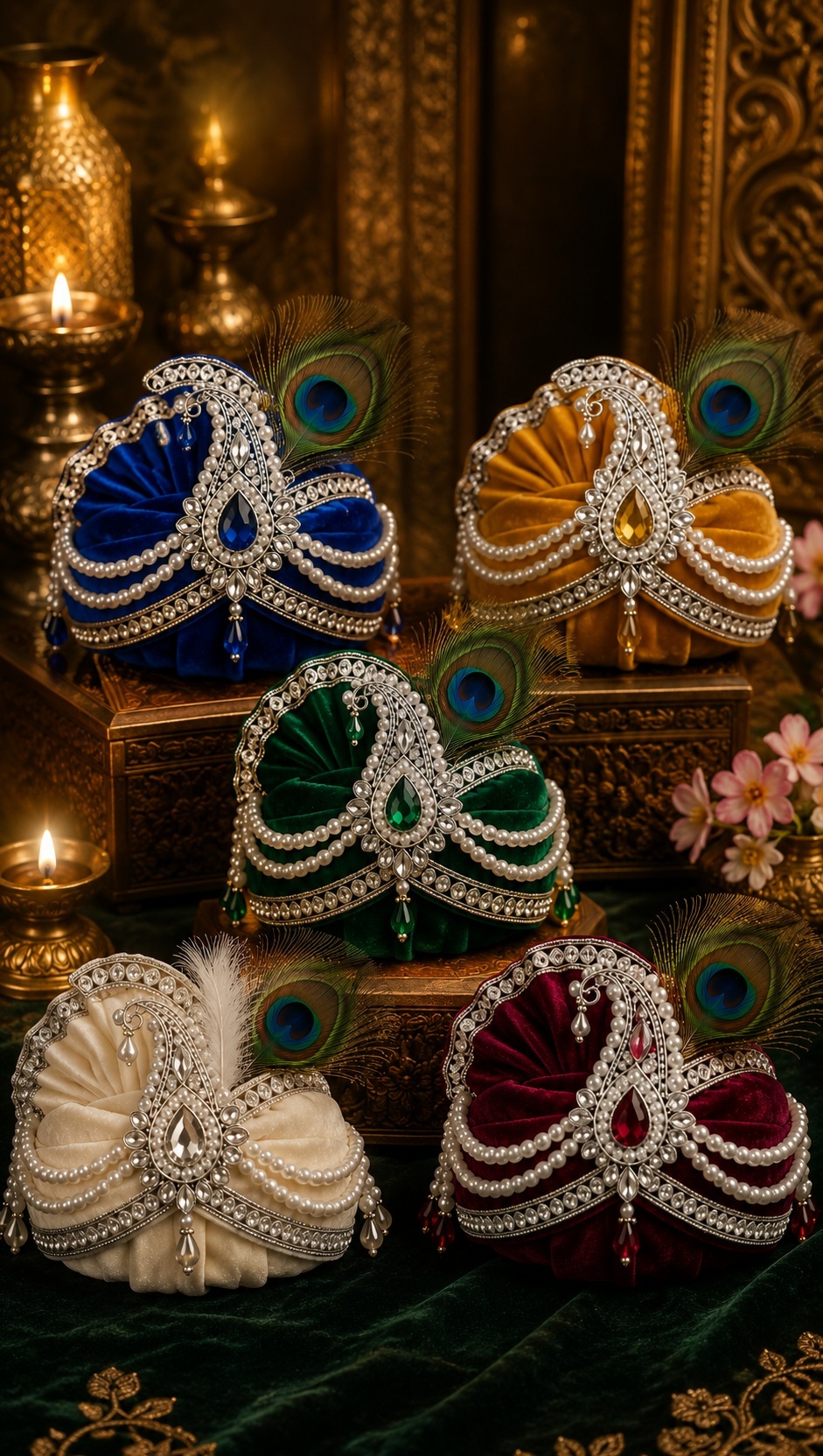
Silver-Tone Mukut with Pearl Detailing
Less common than gold-tone but deeply beautiful in the right context. A silver-tone mukut with pearl or crystal detailing pairs naturally with midnight blue or ivory poshak, the cooler metal tone complements cooler poshak colors in a way that gold-tone cannot.
Best with: Midnight blue Kanha Ji poshak, white or ivory Janmashtami dress, pale festival colors
Mukut Shapes, Why Some Are Taller, Rounder, or Fan-Shaped
This is the dimension of mukut selection that almost nobody explains, and it makes a genuine visual difference.
Tall cylindrical mukut: The most traditional temple-style shape. A tall mukut creates vertical presence and communicates regal height. It suits larger Kanha Ji figures (size 5 and above) where there is enough visual mass to support the height. On a smaller Kanha Ji, a very tall mukut can look disproportionate.
Rounded dome mukut: A softer, rounder crown shape. More appropriate for smaller Kanha Ji, it adds presence without overwhelming. Many daily shringar mukuts follow a dome shape because it is stable, elegant, and practical.
Fan-shaped or spread mukut: A wider mukut with a flat, fan-like upper section, particularly visible from the front. It creates a dramatic visual frame for the face and suits photographs especially well. This is often the preferred choice for Janmashtami darshan photography.
The principle: taller and more dramatic for larger Kanha Ji and festival occasions; softer and rounder for smaller figures and daily shringar.
Pagdi, Cloth Wrapping and Winter Caps, How Head Coverings Affect Mukut Choice
Many Kanha Ji figures, particularly in winter months, are dressed with a small pagdi (turban), a soft cloth wrapping, or a woolen cap as part of seasonal shringar. This creates a practical consideration for mukut selection that is rarely discussed.
When Kanha Ji wears a pagdi: The head circumference is now slightly larger than the bare measurement. A mukut sized for the bare head will fit more tightly or even not sit over a pagdi. If you regularly use a pagdi in your winter shringar routine, consider keeping a slightly larger mukut for those occasions, or place the mukut first and add the pagdi decoratively alongside.
When Kanha Ji wears a winter cap: Similarly, a woolen cap increases head volume. Many devout households use the mukut for daytime darshan and transition to just the cap for evening seva when the mandir is at rest, which is equally beautiful and completely traditional.
The pagdi as its own shringar: In some traditions, a beautifully folded and decorated pagdi is the primary head shringar, used instead of a formal mukut. This is as traditional as any mukut style and is widely practiced, particularly for certain festival occasions.
Matching Mukut to Poshak, The Metal Tone Rule
This is the rule that most simplifies mukut coordination: always match metal tone across the entire shringar.
If Kanha Ji's jewellery set is gold-tone, the mukut should be gold-tone. If the jewellery is silver-tone, the mukut should be silver-tone. Mixing gold and silver at the most prominent point of the shringar, where the mukut sits at the top, creates visual inconsistency that the eye registers immediately even without consciously identifying the source.
Beyond metal tone, consider embellishment weight. A heavy, elaborate Janmashtami poshak calls for a mukut of similar visual weight, a substantial, detailed crown rather than a simple, minimalist one. A daily cotton poshak for Kanha Ji benefits from a lighter, simpler mukut, elaborate stone work can feel overwrought against plain cotton fabric.
| Poshak Type | Mukut Weight | Recommended Style |
|---|---|---|
| Daily cotton / summer dress | Light | Simple gold-tone or plain brass |
| Art silk / medium occasion | Medium | Standard stone-work gold-tone |
| Heavy zari / Banarasi festival | Substantial | Kundan or elaborate stone-work |
| Handmade Kanha Ji poshak | Substantial | Mor pankh or elaborate kundan |
| Radha Rani Ji poshak (Yugal Jodi) | Matching to Kanha Ji | Coordinated in same tone and weight |
Quick Comparison, Mukut Style by Occasion
| Mukut Style | Best For | Daily or Festival |
|---|---|---|
| Gold stone-work | Most poshak types | Both |
| Mor pankh | Janmashtami, high significance | Festival |
| Kundan | Heavy zari / Banarasi poshak | Festival |
| Silver with pearl | Midnight blue / white poshak | Both |
| Simple brass dome | Daily cotton shringar | Daily |
Should Every Poshak Have Its Own Mukut?
This is a question many devotees have but rarely find a direct answer to: when you buy a new Kanha Ji dress, do you also need to buy a new mukut?
The honest answer is no, not necessarily.
If you build a small, thoughtful mukut collection of three pieces, you can coordinate almost every poshak you will ever own:
- One gold-tone stone-work mukut: Covers most warm-color poshak, yellow, orange, red, peacock, deep blue
- One silver-tone or pearl mukut: Covers white, ivory, midnight blue, and any cool-color poshak
- One mor pankh mukut: Reserved for Janmashtami and high-significance occasions regardless of poshak color
With these three, the vast majority of Kanha Ji poshak, cotton daily dress, Kanha Ji silk dress, heavy Janmashtami poshak, handmade Kanha Ji poshak, can be dressed completely without ever needing to buy a mukut that matches a single specific outfit.
The exception: if a poshak is so distinctive in style or color that none of the three creates a natural match, a fourth specific mukut may be worthwhile. But for most devotees, three well-chosen mukuts serve every occasion across the year.
Mukut for Daily Shringar vs Festival Shringar
This distinction is worth making clearly, because many devotees use a single mukut across all occasions, which is not wrong but represents a missed opportunity.
Daily shringar mukut: Lighter, simpler, easy to place and remove. Should be sturdy enough to withstand regular handling without bending. Brass or light gold-tone with minimal stone work is practical and appropriate for daily use. A daily cotton poshak for Kanha Ji looks exactly right with this kind of understated mukut.
Festival shringar mukut: Heavier, more elaborate, reserved for significant occasions. A Janmashtami special heavy zari dress deserves a mukut that matches its elaborateness. This is the piece where investment in quality shows, a well-made festival mukut looks dramatically different from a mass-produced one in the diya and aarti light that defines the festival moment.
Many experienced devotees maintain two mukuts for exactly this reason, a daily-use piece for the regular shringar rotation, and a festival piece that comes out for Janmashtami, Diwali, and other major occasions alongside the heavy poshak.
The Mor Pankh, Understanding Its Significance
The peacock feather deserves its own discussion because it is one of the most searched and most misunderstood elements of Kanha Ji's shringar.
The mor pankh, peacock feather, is described in classical texts as one of Kanha Ji's primary adornments. Its iridescent blue-green colors are said to reflect the divine nature of creation. Its presence in the mukut connects the shringar to the forest of Vrindavan, where peacocks are described as dancing when Kanha Ji plays the bansuri.
In practical terms, a mor pankh in the mukut can be:
- A real peacock feather placed into a simple mukut band, the most traditional form
- A crafted feather element made from metal or fabric that mimics the peacock feather form
- An integrated mukut design where the feather is part of the overall crown structure
All three are appropriate. The real feather carries the most direct connection to the tradition. The crafted version is more durable for regular use and does not fade or deteriorate with time.
Common Mukut Mistakes to Avoid
Choosing style before sizing. The most beautiful mukut that does not sit stable is worse than a simple one that fits well. Always confirm inner diameter measurement before choosing style.
Matching mukut metal to poshak color rather than jewellery metal. The mukut should match the jewellery, not the poshak. If the jewellery is gold-tone, the mukut is gold-tone, regardless of whether the poshak is blue, yellow, or white.
Using a festival mukut for daily shringar. A heavily crafted festival mukut handled daily will show wear and tarnishing much faster. Reserve it for its purpose.
Placing the mukut too far forward. The mukut should sit at the crown of Kanha Ji's head, not tilted forward over the face. This is the position in classical temple shringar and it creates the most dignified appearance.
Buying without checking inner diameter when ordering online. Unlike poshak where a number directly maps to idol height, mukut sizing requires the inner diameter measurement. Always check this specification when purchasing online.
Divyambar's Seva Insight The mukut is often the last element chosen in a shringar preparation, but it deserves to be among the first. The quality of the mukut determines whether the entire shringar reads as deliberate or assembled. A poshak chosen in the light of its mukut will always look more complete than one chosen independently of it.
When creating a new poshak collection at Divyambar, our designers also consider which mukut style and metal tone will create the most harmonious darshan alongside each piece. Color palettes, embellishment weights, and border designs are planned with the knowledge of what mukut will accompany them, which is why a Divyambar poshak tends to look complete rather than requiring additional coordination effort.
When choosing your next Laddu Gopal or Kanha Ji poshak, consider the mukut alongside it. Our Laddu Gopal dress collection includes handcrafted poshak designed so the mukut coordination is already built into each piece.
The poshak dresses Kanha Ji. The mukut makes Him King. The final element placed in the shringar is often the first element the eye notices, which means choosing the right mukut is not about completing the preparation. It is about completing the darshan.
Continue Your Janmashtami Preparation
- Janmashtami Shringar, Mukut, Jewellery & Accessories Guide
- Janmashtami Laddu Gopal Dress 2026, Complete Guide
- Laddu Gopal Poshak Size Chart, Complete Measurement Guide
- Radha Krishna Dress for Janmashtami, Yugal Jodi Shringar Guide
Frequently Asked Questions
How do I choose the right size mukut for Laddu Gopal?
Measure the head circumference of Kanha Ji at the widest point using a soft tape or thread. The inner band diameter of the mukut should closely match this measurement. If the mukut tilts or sits loosely, a small piece of cotton wool inside the band creates stable positioning. Do not choose mukut size based on idol height alone, head shape varies even within the same height.
Which mukut style is best for Kanha Ji?
A gold-tone stone-work mukut is the most versatile and appropriate for most occasions and poshak types. A mor pankh mukut carries the deepest theological significance for Krishna devotees and is particularly appropriate for Janmashtami. A kundan mukut pairs best with Banarasi silk and heavy embroidery poshak. Choose based on the occasion and the poshak it will accompany.
What is the significance of the mor pankh mukut for Kanha Ji?
The peacock feather is one of Kanha Ji's most recognizable symbols, described in classical devotional texts as part of His forest adornment. In shringar, the mor pankh connects the crown to the Vrindavan tradition where Kanha Ji is inseparable from the natural world. Many devotees choose the mor pankh mukut for Janmashtami specifically for this theological resonance.
Should the mukut match the poshak color or the jewellery?
The mukut should match the jewellery metal tone, not the poshak color. If the jewellery set is gold-tone, the mukut should be gold-tone regardless of poshak color. Matching metal tones across mukut and jewellery creates visual consistency at the most prominent points of the shringar.
Can I use the same mukut for both daily shringar and festival occasions?
Yes, though many experienced devotees keep two separate mukuts. A lighter, simpler mukut is more practical for daily handling and suits everyday poshak like cotton Kanha Ji dress. A more elaborate festival mukut pairs with a heavy Janmashtami dress or handmade Kanha Ji poshak and should be used selectively rather than daily.
How do I clean and care for a Laddu Gopal mukut?
For metal mukuts: gently wipe with a soft, dry cloth after each use. Avoid water unless the seller specifies it is safe. For stone-set mukuts, avoid soaking which can loosen stone settings. Store in a soft pouch away from direct sunlight. Tarnished mukuts can often be gently polished with a clean dry cloth, for more significant tarnishing, consult a jeweller.
Kanha Ji ke liye mukut kaise choose karein?
Kanha Ji ke sir ki circumference measure karein, height nahi. Mukut ka inner band diameter usi measurement ke close hona chahiye. Metal tone jewellery se match karein, poshak color se nahi. Daily shringar ke liye simple gold-tone, festival ke liye elaborate kundan ya mor pankh. Agar mukut tilt karta hai toh andar cotton wool rakhne se stability aati hai. Festival mukut, Janmashtami heavy dress ya handmade Kanha Ji poshak ke saath, alag rakhein.