Janmashtami Laddu Gopal Shringar — Complete Mukut, Jewellery & Poshak Guide
The complete Janmashtami shringar guide for Laddu Gopal — mukut selection, jewellery set, bansuri, kamarbandh, payal, and how to layer accessories with poshak for the most complete Kanha Ji birthday look.
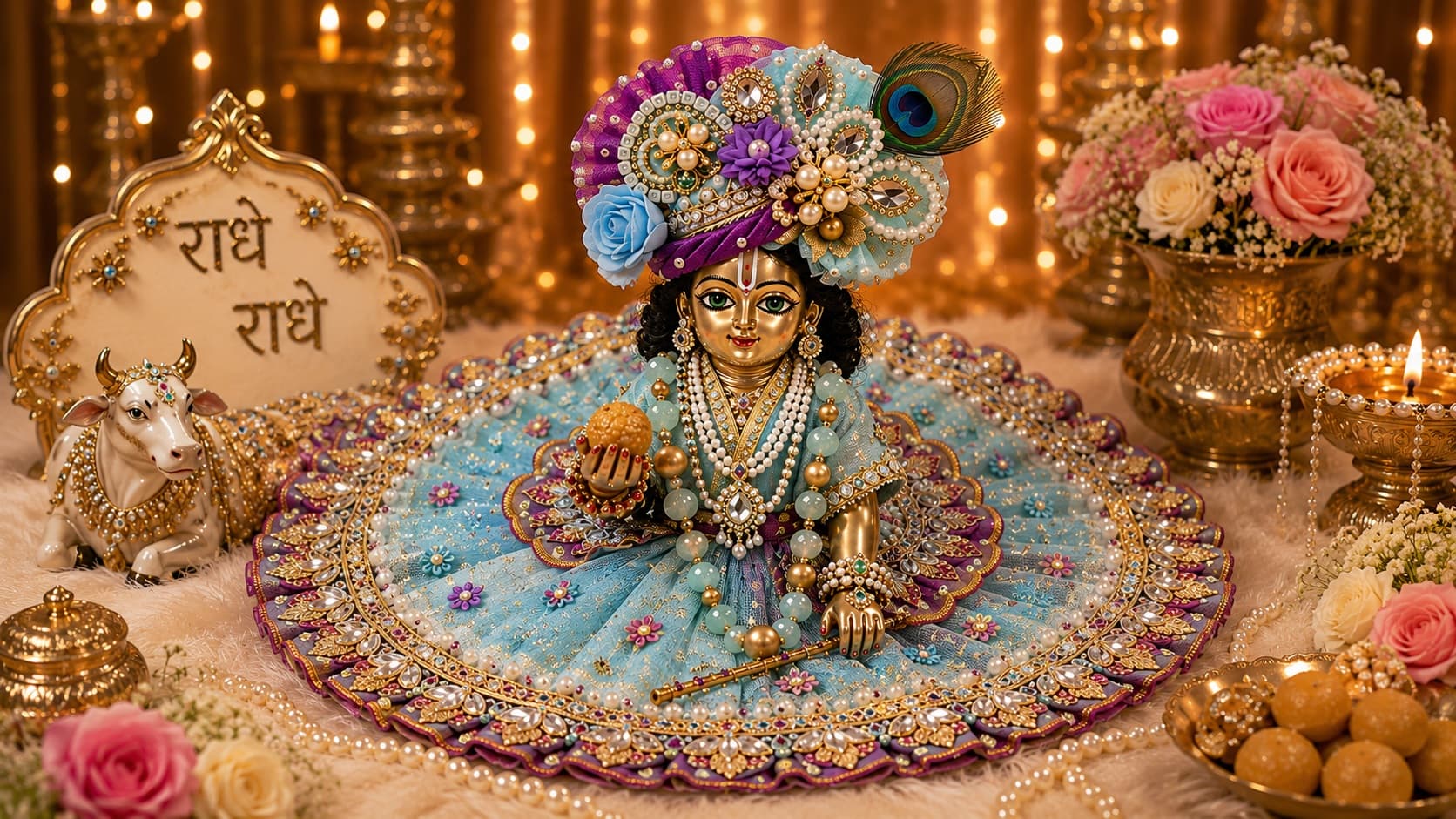 Janmashtami Laddu Gopal Shringar — Complete Mukut, Jewellery & Poshak Guide
Here is something almost every devotee discovers the hard way, usually a few days before Janmashtami.
You have ordered the most beautiful Janmashtami laddu gopal poshak,heavy zari, the right color, the right size. It arrives. You dress Kanha Ji. And something is still missing.
The mukut does not quite match. The jewellery you have is the same simple set used every day. There is no bansuri. The shringar feels incomplete in a way that is hard to name but easy to feel.
This is often the part of Janmashtami preparation that receives the least attention, even though it is what makes the entire shringar feel complete. A genuine Laddu Gopal shringar set is not just the dress,it is the mukut, the jewellery, the bansuri, the kamarbandh together.
This guide covers exactly that,the layer of shringar that exists beyond daily routine, reserved for the most significant night of the year. For the everyday version of this practice, our daily shringar guide for Laddu Gopal covers the simpler routine most households follow outside of major festivals.
This guide reflects traditional Janmashtami shringar practices followed by devout households and the accessory conventions used by karigars in Vrindavan and Mathura. For the poshak itself, see our complete Janmashtami dress guide and size-by-size buying guide. Last updated August 2026.
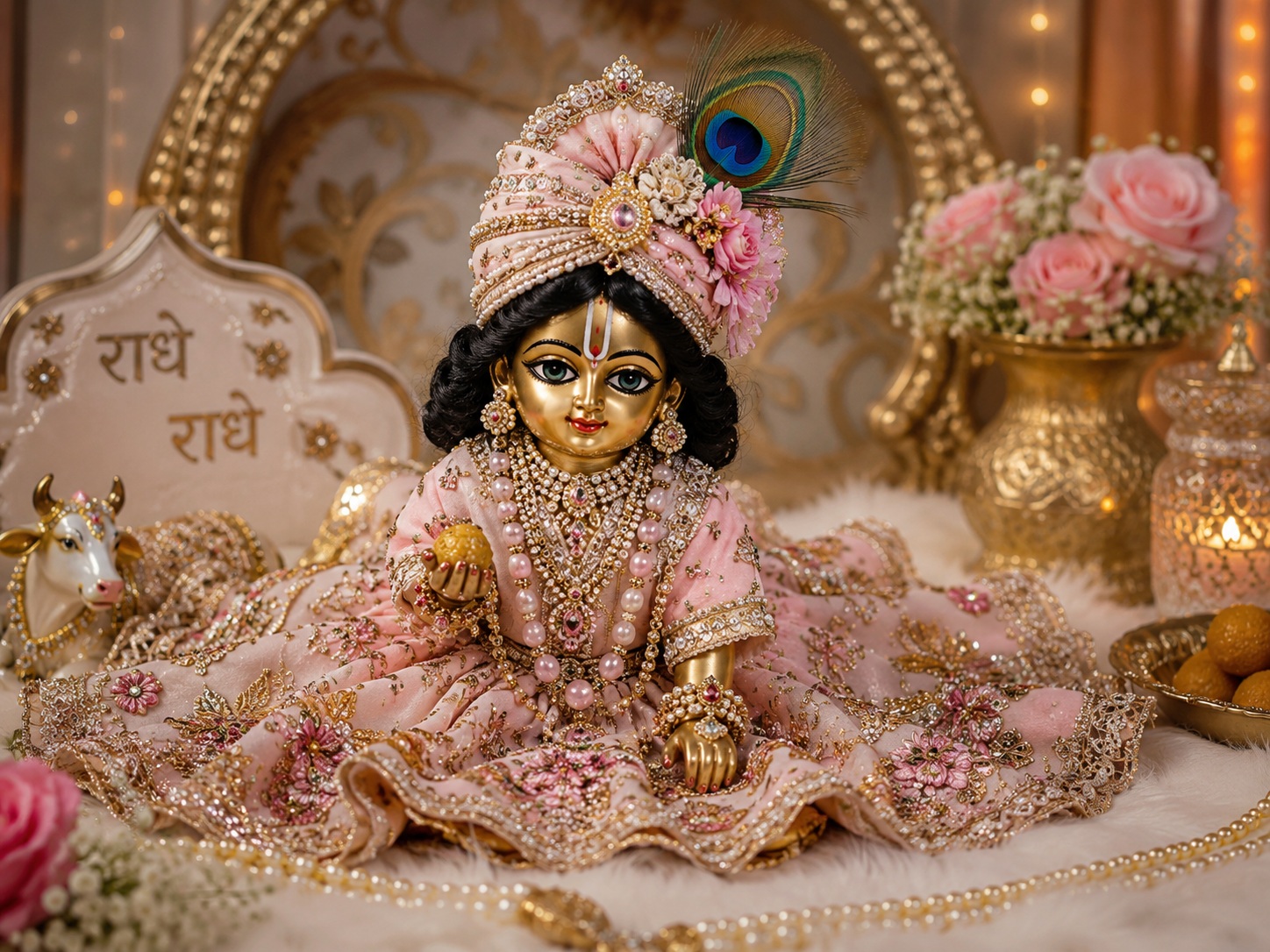
What does a complete Janmashtami shringar include? A complete Janmashtami shringar for Laddu Gopal includes the poshak, a matching mukut, a jewellery set (haar, kundal, kangan, kamarbandh), a bansuri, payal, and fresh flowers. Together these elements create the full traditional appearance associated with Kanha Ji's birthday celebration,far beyond the poshak alone.
Quick Reference,Complete Shringar Checklist
- Poshak (matched to size and color)
- Mukut (matched to poshak color and idol size)
- Jewellery set: haar, kundal (earrings), kangan (bangles)
- Kamarbandh (waist belt)
- Payal (anklets)
- Bansuri (flute),Kanha Ji's signature accessory
- Fresh flowers,marigold and jasmine
Why the Mukut and Jewellery Matter as Much as the Poshak
There is a reason temple deities,in Vrindavan's Banke Bihari, in Mathura, in every major Krishna temple,are never adorned with poshak alone. The complete shringar tradition has always understood that the dress is one part of a layered presentation, not the entire presentation.
A heavy zari Laddu Gopal dress or Janmashtami poshak without a proper matching mukut looks unfinished, the way a beautifully tailored outfit looks incomplete without the right accessories. The mukut is what gives Kanha Ji His regal presence,it is, quite literally, the crown of the entire shringar.
"Poshak Kanha Ji ko pehnaya jaata hai. Mukut aur shringar Unhe Raja banate hain." (The poshak is what Kanha Ji is dressed in. The mukut and jewellery are what make Him King.)
Every Complete Janmashtami Shringar Starts with the Right Poshak
Before choosing a mukut, jewellery set, or bansuri, the most important decision is still the Janmashtami poshak itself. The color, embroidery, fabric, and silhouette of the dress determine how every other accessory will look.
A heavily embroidered Laddu Gopal dress pairs best with a richer mukut and jewellery set, while a lighter Kanha Ji dress often benefits from more restrained accessories. Many devotees therefore choose the poshak first and build the rest of the Janmashtami shringar around it.
If you are still deciding on the dress itself, explore our collection of Laddu Gopal dresses before finalizing your Janmashtami accessories.
What Is the Most Important Accessory After the Poshak?
If a devotee can only add one accessory beyond the poshak this Janmashtami, the answer is almost always the mukut.
The mukut is usually the most transformative single addition because it changes the entire visual presence of the shringar more than any other piece. A simple poshak with a well-chosen mukut often looks more complete than an elaborate poshak with no mukut at all,the crown is what signals regality, and regality is central to how Kanha Ji is honored on His birthday.
If budget or time allows for only one purchase this year beyond the dress itself, a properly sized Laddu Gopal mukut delivers the most visible transformation. The bansuri is the second most valuable addition,inexpensive, iconographically essential, and easy to source even close to the festival. Jewellery sets, while beautiful, complete the look rather than transform it the way a mukut does.
Which Mukut Is Most Popular for Janmashtami?
Among devotees shopping for Janmashtami specifically, three mukut styles consistently stand out as the most chosen.
Gold-tone stone mukut is the most widely purchased style,traditional, versatile, and pairs with nearly every Janmashtami poshak color. This is the default choice for most households.
Mor pankh (peacock feather) mukut is the second most popular, chosen specifically for its deep theological significance to Krishna devotees rather than purely for appearance.
Kundan-work mukut is the preferred choice among devotees building a premium shringar set, valued for its visual richness without excessive weight on the idol.
For most devotees searching for a Laddu Gopal mukut online this Janmashtami, a gold-tone stone mukut sized correctly to the idol remains the safest and most universally appropriate choice.
Choosing the Right Laddu Gopal Mukut for Janmashtami
Mukut Sizing,Matched to Your Idol
A Laddu Gopal mukut should be sized to your idol the same way poshak is,based on the idol's height. A mukut too large will not sit stable and will tilt or slide. A mukut too small will look disproportionate against a heavy, full poshak.
For sizing guidance specific to your idol,whether 3 number, 4 number, or larger,our complete size 0 to 10 guide covers exact measurements that also apply to mukut and accessory selection.
Mukut Styles for Janmashtami
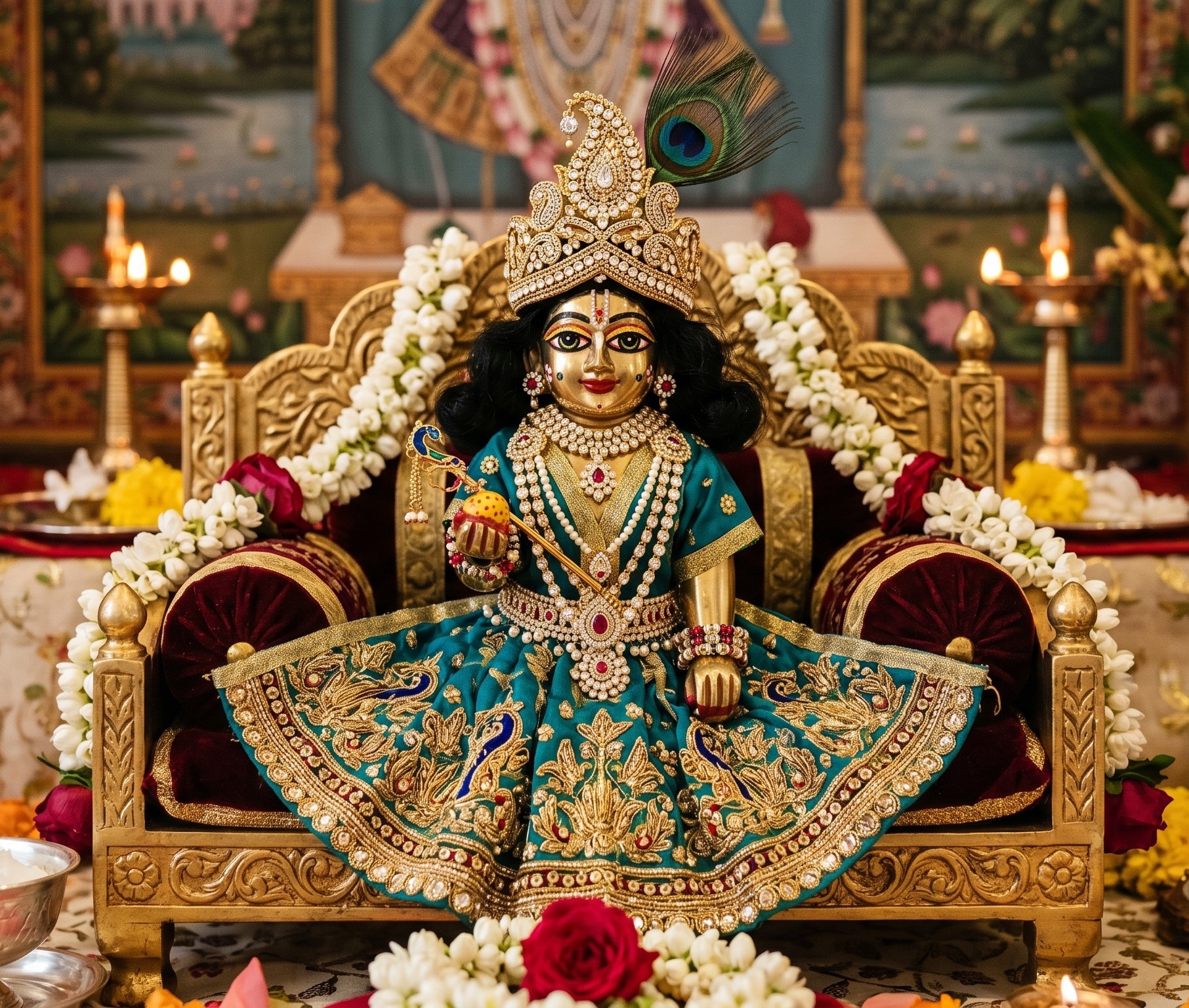
Gold-tone mukut with stone work,The most traditional and widely chosen style for Janmashtami. Pairs beautifully with yellow pitambar and Banarasi silk poshak. The gold tone catches diya light during the midnight Nishita Puja in a way that elevates the entire shringar.
Peacock feather mukut (mor pankh),Deeply significant for Krishna devotees. The peacock feather represents purity, harmony, and is one of Kanha Ji's most recognizable symbols. A mukut with an integrated mor pankh, or a separate feather tucked into a simpler mukut, is one of the most theologically resonant choices for Janmashtami.
Silver-tone mukut with pearl detailing,Pairs elegantly with midnight blue poshak. The cooler tone of silver against deep blue fabric creates a striking, regal contrast,particularly beautiful for the midnight shringar moment.
Kundan-work mukut,For devotees building a premium shringar set, kundan stone work mukuts offer significant visual richness without the weight of larger stone settings, making them comfortable for the idol while still being visually substantial.
Matching Mukut to Poshak Color
Yellow pitambar Laddu Gopal dresses are traditionally paired with gold-tone mukuts and stone work jewellery,the warmth of the gold against the yellow fabric is part of why this combination remains the most chosen Janmashtami look year after year. You can browse yellow and gold Janmashtami poshak options here.
| Poshak Color | Recommended Mukut |
|---|---|
| Yellow pitambar | Gold-tone with stone work |
| Midnight blue | Silver-tone with pearl detailing |
| Ivory/white (midnight shringar) | Gold with subtle pearl accents |
| Peacock green | Gold-tone with mor pankh |
Laddu Gopal Jewellery Set for Janmashtami Shringar
A full Laddu Gopal jewellery set typically includes several distinct pieces, each with its own traditional purpose.
How to Choose a Laddu Gopal Jewellery Set
Selecting jewellery is not just about what looks beautiful in a product photo,a few practical factors genuinely determine whether a set works for your specific idol.
Match the metal tone to your mukut and poshak. A gold-tone jewellery set with a silver-tone mukut creates visual inconsistency. Decide on one dominant metal tone,gold is more traditional and versatile, silver pairs distinctly with midnight blue and cooler poshak colors,and stay consistent across haar, kundal, and kangan.
Consider idol size carefully. A size 2-3 idol needs genuinely delicate, lightweight jewellery; oversized pieces will look like they are wearing the idol rather than adorning it. Size 5-6 idols can carry fuller, more substantial jewellery without appearing cluttered.
Decide between daily and festival use. A jewellery set intended only for festivals like Janmashtami can be heavier and more elaborate,stone work, kundan detailing, multiple layered haars. A set meant for regular use should be simpler and more durable for frequent handling.
Stone work versus kundan. Stone work (small inlaid gemstones or colored glass settings) offers more visual color and sparkle, often suited to festival pieces. Kundan work (traditional gold-foil set glass) offers a softer, more antique richness that pairs beautifully with Banarasi silk and is often preferred for a more traditional, temple-style appearance.
Heavy zari Laddu Gopal dresses provide the strongest visual foundation for a complete Janmashtami jewellery set,the richness of the embroidery and the richness of gold-tone jewellery elevate each other rather than competing. Browse our handmade Kanha Ji poshak collection to see how poshak and jewellery work together.
Haar (Necklace/Garland)
The haar is often the centerpiece of the jewellery set,sitting prominently against the poshak's front panel. For Janmashtami, a substantial gold-tone haar with stone or kundan work creates the most visually complete look. Many devotees layer a smaller haar closer to the neck with a longer one resting lower against the poshak.
A fresh flower haar,marigold or jasmine,worn over or alongside the jewellery haar is a beautiful Janmashtami-specific addition, combining the permanence of jewellery with the freshness of the offering.
Kundal (Earrings)
Small, often peacock or floral-shaped earrings complete the facial shringar. These should be proportionate to idol size,a size 3 or 4 idol needs delicate, lightweight kundal, while larger idols (size 5-6) can carry slightly more elaborate earring designs without looking disproportionate.
Kangan (Bangles)
Bangles for Laddu Gopal are typically worn on both wrists, visible where the poshak sleeves end. Gold-tone kangan with small bells or stone detailing are traditional. The faint sound of small bells during movement or aarti adds a sensory dimension that many devotees specifically value.
Kamarbandh (Waist Belt)
The kamarbandh,sometimes called tagdi,sits at the waist over the poshak, defining the silhouette and adding a layer of richness to the overall shringar. For heavy Janmashtami poshak, a coordinating kamarbandh in gold-tone with stone work completes the regal appearance the occasion calls for.
Payal (Anklets)
Small anklets, often with tiny bells, complete the shringar at the feet. Like kangan, the soft sound during aarti or movement is considered an auspicious, joyful addition specifically appropriate for a celebratory occasion like Janmashtami.
Bansuri,The Most Iconic Krishna Accessory
No discussion of Kanha Ji's shringar is complete without the bansuri (flute). It is arguably Krishna's most recognizable and theologically significant accessory,inseparable from His identity across every depiction, every bhajan, every temple image.
A small bansuri, proportioned to the idol's hand and size, placed in or near Kanha Ji's hand during Janmashtami shringar completes the iconography in a way nothing else can. For idols already holding the traditional flute mudra (hand position), a properly sized bansuri placed in that hand is one of the most important finishing touches of the entire shringar.
For Janmashtami specifically, many devotees choose a slightly more ornate bansuri than their daily one,gold-tone with subtle detailing rather than plain,to match the elevated quality of the occasion's overall shringar.
What Should Be Included in a Complete Laddu Gopal Shringar Set?
Pulling everything together, here is the full answer to the question most devotees are actually asking when they search for a complete Laddu Gopal shringar set:
- Mukut,the crown, matched to idol size and poshak color
- Haar,necklace, often layered with a fresh flower garland
- Kundal,earrings, proportionate to idol size
- Kangan,bangles, worn at both wrists
- Kamarbandh,waist belt, defining the silhouette over the poshak
- Payal,anklets, often with small bells
- Bansuri,the flute, Krishna's most iconic accessory
A poshak alone is the foundation. These seven elements together are what most devout households consider a genuinely complete Janmashtami shringar.
Which Janmashtami Shringar Combination Is Most Popular?
For devotees who want the single most trusted answer without weighing every option, here is what most devout households actually choose, year after year:
- Poshak: Yellow pitambar Laddu Gopal dress in Banarasi silk with heavy zari
- Mukut: Gold-tone with stone work
- Jewellery: Gold jewellery set,haar, kundal, kangan
- Signature accessory: Mor pankh (peacock feather)
- Final touch: Fresh marigold flowers and a bansuri in hand
This combination is not the only beautiful option, but it is the one most consistently chosen across Vrindavan tradition and devout households across India,and a reliable starting point if you are putting together your first complete Janmashtami shringar.
How to Layer the Complete Shringar,Step by Step
Putting together mukut, jewellery, poshak, and bansuri without the result looking cluttered requires a specific sequence.
1. Poshak first. Dress Kanha Ji in the Janmashtami poshak, fully settled and arranged before adding anything else.
2. Kamarbandh second. Add the waist belt over the poshak, positioned to define the waist clearly without sitting too high or too low.
3. Kangan and payal third. Slide bangles onto the wrists where the poshak sleeves end, and anklets at the feet.
4. Haar fourth. Layer the necklace pieces,jewellery haar first, then a fresh flower haar over or alongside it if using both.
5. Kundal fifth. Add earrings last among the jewellery pieces, since they are the most delicate and easiest to disturb if added earlier.
6. Mukut sixth. Place the mukut last among the major elements,this way, nothing else needs adjustment after the most visually important piece is positioned.
7. Bansuri last. Place the flute in the hand or mudra position as the final element,this is often the moment that makes the shringar feel complete.
8. Fresh flowers throughout and at the end. A few final touches,a flower tucked near the mukut, petals at the base of the singhasan,complete the presentation.
Shringar Set by Idol Size
Accessory proportions matter as much as poshak sizing. Here is what to consider by size range:
| Idol Size | Mukut Scale | Jewellery Weight | Bansuri Size |
|---|---|---|---|
| Size 2–3 | Delicate, lightweight | Fine, minimal stone work | Small, proportionate |
| Size 4 | Standard, most widely available | Medium weight, moderate detailing | Standard |
| Size 5–6 | Larger, more elaborate | Fuller jewellery set, more substantial stones | Slightly larger |
| Size 7+ | Custom-proportioned | Custom or temple-style sets | Custom |
For idols at size 4,the most common size in India,the widest range of standard mukut and jewellery sets exists. For complete sizing across the full range, see our Laddu Gopal size 0 to 10 guide. For accessory care between festivals and seasonal poshak rotation, our summer dress guide for Laddu Gopal covers how to maintain your daily shringar through the warmer months leading up to Janmashtami.
Building a Complete Shringar Set on a Budget
A genuine concern for many devotees: a complete shringar set sounds expensive. Here is a practical way to think about it.
Many families build their Kanha Ji's shringar gradually over several Janmashtamis rather than all at once,and there is nothing incomplete about that approach. Many devotees begin with a well-made Laddu Gopal dress and add mukut, jewellery, and other accessories over the following years. A mukut added this year, a kamarbandh next year, payal the year after,each addition becomes its own small offering, its own memory tied to a particular Janmashtami.
Start with the essentials. A mukut and one jewellery set (haar, kundal, kangan together) covers the core of the shringar. Kamarbandh, payal, and bansuri can be added gradually over subsequent festivals if budget is a real constraint this year.
Invest in the mukut first. Of all the accessories, the mukut has the most visual impact relative to its cost. A well-chosen mukut elevates a simple poshak more than any other single addition.
The bansuri is inexpensive and essential. Among all shringar accessories, a good bansuri is typically the most affordable while being the most iconographically important. This is a worthwhile early addition even on a tight budget.
Reuse across festivals. Unlike poshak, which devotees often rotate seasonally, a quality mukut and jewellery set can be reused across Janmashtami, Diwali, and other major festivals for years,making it a one-time investment rather than a recurring cost.
Radha Rani Shringar for Yugal Jodi Janmashtami
For devotees with a Kanhaji Darbar or Yugal Jodi setup, Radha Rani's shringar should be coordinated alongside Kanha Ji's,complementary, not identical.
Radha Rani's jewellery typically includes a nath (nose ring), a more elaborate haar arrangement, and bangles that coordinate in tone with Kanha Ji's kangan. A matching or complementary mukut,often called a mor mukut or simpler tiara-style crown depending on tradition,completes Her shringar.
For the Handcrafted Radha Rani lehenga or Radha Rani heavy poshak worn on Janmashtami, gold-tone jewellery with rose or pink stone accents pairs particularly well. The Traditional Radha Rani Chunri and Chandrika, when worn with a complete jewellery set, creates an elegant, more understated Yugal Jodi alternative to heavier festival wear.
Common Mistakes When Putting Together Janmashtami Shringar
Mismatched metal tones. Mixing gold-tone and silver-tone pieces without intention creates visual confusion. Choose one metal tone as the primary and stay consistent across mukut, haar, kangan, and kamarbandh.
Oversized mukut for the idol. A mukut should sit stable without tilting. If it consistently slides, it is too large for the idol,a properly sized mukut is worth the extra effort to find.
Forgetting the bansuri. This is the single most common omission, given how central it is to Krishna iconography. A complete Janmashtami shringar without a bansuri is missing its most recognizable element.
Overcrowding with too many flower elements. Fresh flowers are beautiful, but layering too many garlands, petals, and floral accessories simultaneously can hide the poshak and jewellery rather than complement them. One thoughtful flower element usually works better than several competing ones.
Because every Janmashtami shringar begins with the poshak, our focus remains on handcrafted Banarasi silk and heavy zari festival wear,while helping devotees coordinate the mukut, jewellery, and accessories around it. Reach out to us on WhatsApp if you would like guidance matched to your specific idol size and poshak choice.
Related Guides
- Janmashtami Laddu Gopal Dress 2026,Complete Guide
- Laddu Gopal Dress for Janmashtami by Size 0 to 10
- Laddu Gopal Size 0 to 10,Complete Visual Guide
- Kanha Ji Ke Kapde,Complete Guide
Frequently Asked Questions
What accessories are needed for a complete Janmashtami shringar?
A complete Janmashtami shringar includes the poshak, a matching mukut, a jewellery set (haar, kundal earrings, kangan bangles), a kamarbandh waist belt, payal anklets, and a bansuri. Fresh flowers like marigold and jasmine complete the presentation.
Which mukut is best for Janmashtami?
A gold-tone mukut with stone work is the most traditional choice for Janmashtami, particularly when paired with yellow pitambar poshak. A mukut featuring mor pankh (peacock feather) detailing is deeply significant for Krishna devotees. Silver-tone mukuts with pearl detailing pair beautifully with midnight blue poshak.
Why is the bansuri important for Laddu Gopal shringar?
The bansuri (flute) is one of Krishna's most iconic and theologically significant symbols, appearing in nearly every depiction and devotional reference to Him. A properly sized bansuri placed in or near Kanha Ji's hand completes the iconography of the shringar in a way no other accessory can replace.
How do I choose the right size mukut for my Laddu Gopal?
Mukut size should match your idol's measurement the same way poshak size does,based on idol height. Size 3 and 4 idols need delicate, proportionate mukuts, while size 5-6 idols can carry larger, more elaborate designs. A mukut that consistently tilts or slides is too large for the idol.
What jewellery does Laddu Gopal wear for Janmashtami?
A complete jewellery set includes haar (necklace), kundal (earrings), kangan (bangles), and often a kamarbandh (waist belt) and payal (anklets). Gold-tone jewellery with stone or kundan work is most traditional for Janmashtami, often paired with a fresh flower haar.
What is included in a Laddu Gopal jewellery set?
A standard Laddu Gopal jewellery set includes a haar (necklace), kundal (earrings), and kangan (bangles) as the core pieces. A more complete set adds a kamarbandh (waist belt) and payal (anklets). Gold-tone with stone or kundan work is the most traditional choice, sized proportionately to the idol.
Is a complete shringar set expensive to put together?
It does not need to be done all at once. Start with a mukut and basic jewellery set as the core essentials, add a bansuri (typically the most affordable but most important accessory), and build toward a complete set over subsequent festivals. Quality mukut and jewellery, unlike poshak, can be reused for years across multiple occasions.
Janmashtami ke liye Laddu Gopal ka shringar kaise complete karein?
Janmashtami ke liye complete shringar mein poshak ke saath mukut, haar, kundal, kangan, kamarbandh, payal, aur bansuri shamil hona chahiye. Sabse pehle poshak pehnayen, phir kamarbandh, kangan, payal, haar, kundal, aur sabse aakhir mein mukut aur bansuri. Fresh flowers,marigold aur jasmine,shringar ko complete karte hain.