Radha Krishna Dress for Janmashtami — How to Create a Beautiful Yugal Jodi Shringar at Home
Learn how to coordinate a beautiful Radha Krishna dress for Janmashtami with this complete Yugal Jodi shringar guide. Discover matching colors, fabrics, sizing, Radha Rani poshak, Kanha Ji poshak, accessories, and practical tips for creating a harmonious darshan at home.
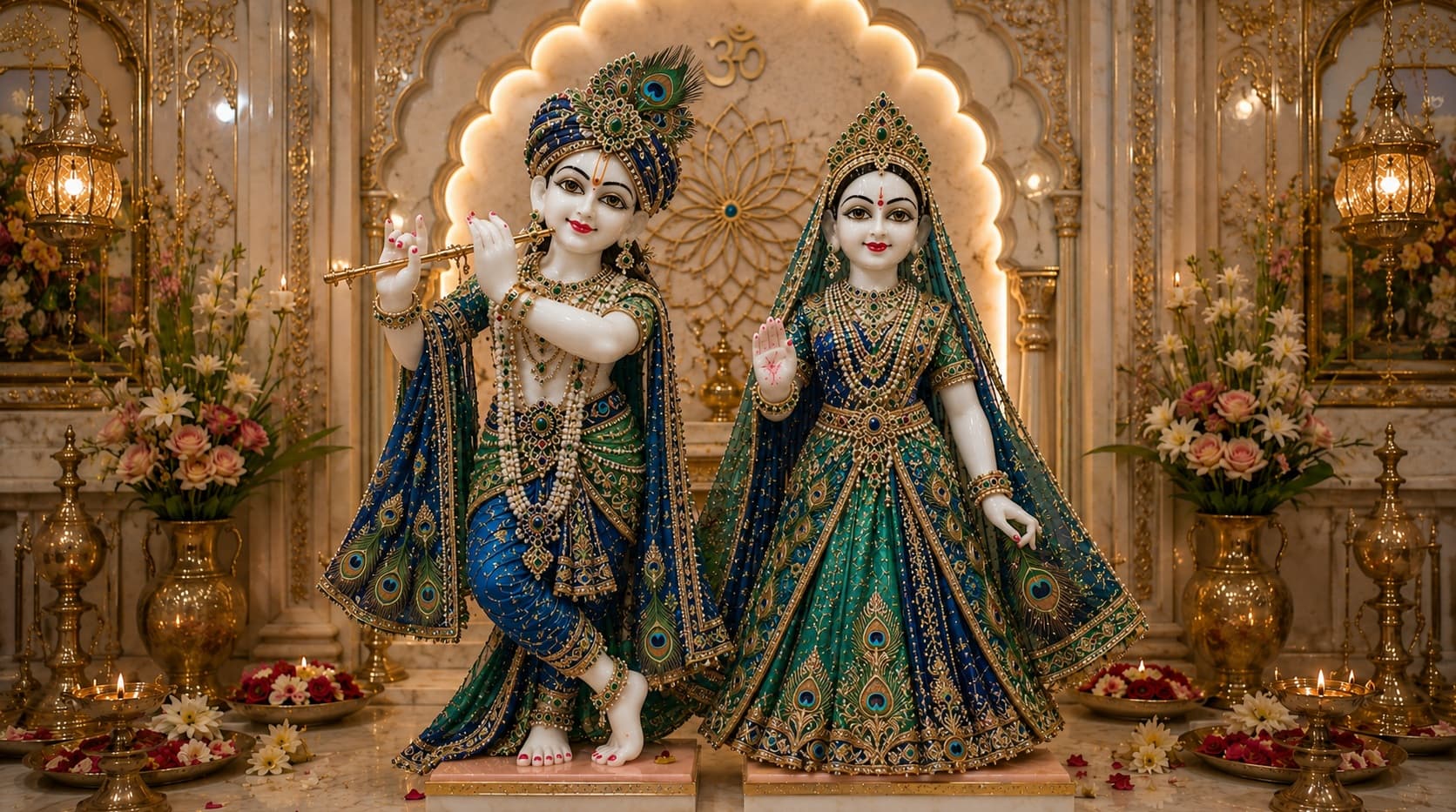 Radha Krishna Dress for Janmashtami — How to Create a Beautiful Yugal Jodi Shringar at Home
Every Janmashtami, many devotees carefully choose the most beautiful Kanha Ji poshak they can find.
But when Radha Rani Ji stands beside Him, something changes.
The question is no longer: "Which dress is more beautiful?"
It becomes: "Do they belong together?"
That is the question this guide answers.
For households where Radha Rani Ji and Kanha Ji are worshipped together, as a Yugal Jodi, as a Kanhaji Darbar, as the paired divine presence at the heart of Vaishnava tradition, Janmashtami preparation has a different quality. It is not simply choosing a Janmashtami dress for one deity. It is creating a complete Radha Krishna shringar, a coordinated presentation in which both Radha Rani Ji and Kanha Ji look as if they belong together, in color, in fabric weight, in embellishment level, and in the spirit of the occasion.
This guide covers exactly that.
This guide reflects Yugal Jodi shringar traditions practiced in Vaishnava households and in the major Kanha Ji Darbar temples of Vrindavan and Mathura. Last updated August 2026.
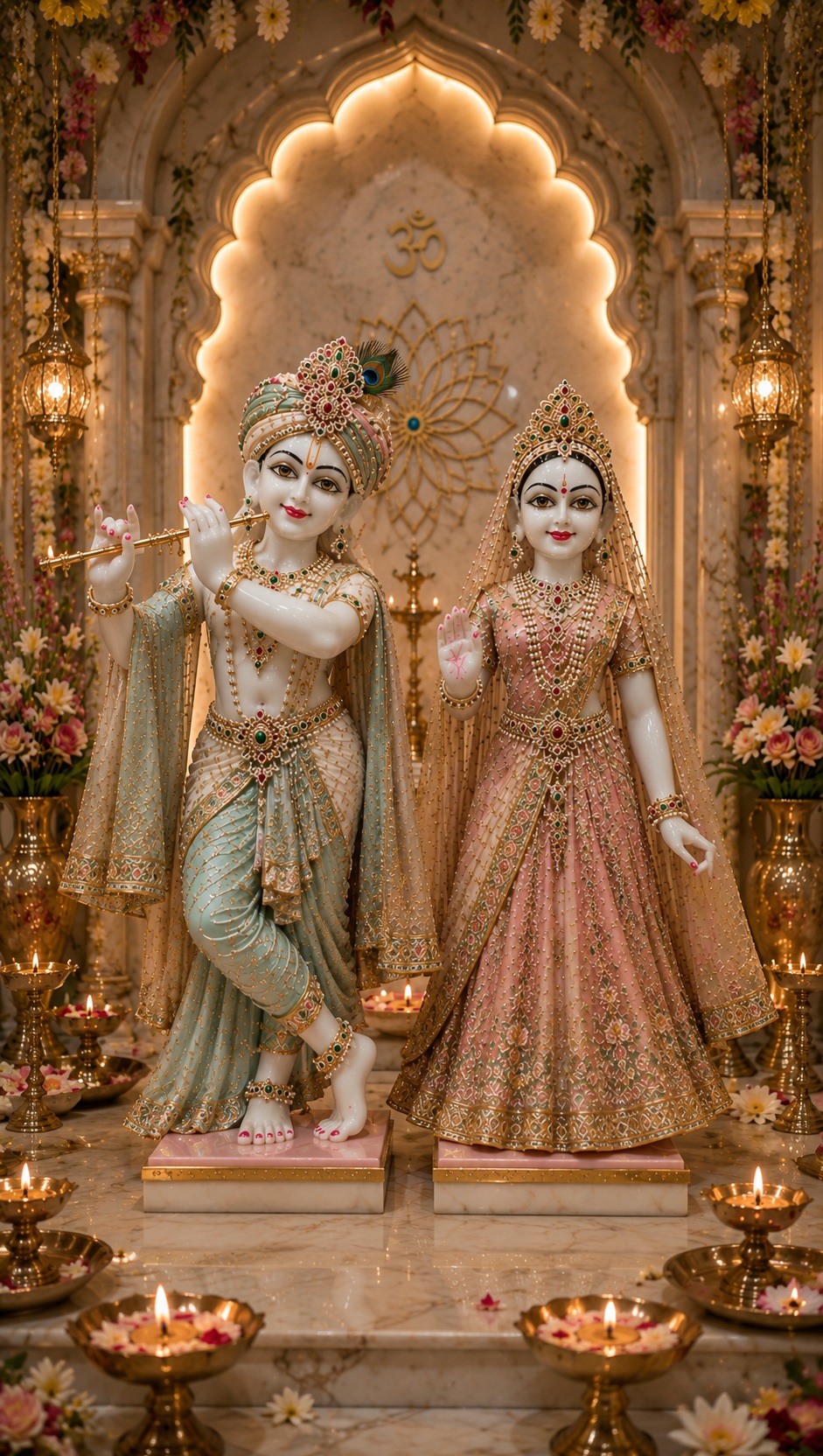
What is Yugal Jodi shringar for Janmashtami? Yugal Jodi shringar refers to the coordinated dressing of Radha Rani Ji and Kanha Ji together as a divine pair for Janmashtami. A matching Radha Krishna dress means the poshak of both deities shares complementary colors, similar fabric weight, and a consistent embellishment level, creating a unified visual presentation rather than two separately dressed deities placed next to each other.
Quick Reference, Yugal Jodi Janmashtami Coordination
- Measure Radha Rani Ji and Kanha Ji separately, sizes are almost always different
- Color: complementary, not identical, Radha Rani Ji in contrast colors
- Fabric: match the weight, both heavy, or both light
- Embellishment: match the level, same elaborateness for both
- Order both together, paired sets ensure coordination is designed in
- Radha Rani Ji is typically 1–2 sizes larger than Kanha Ji in the same setup
Why Radha Rani Ji and Kanha Ji Are Worshipped Together
Before discussing how to coordinate their poshak, it is worth understanding why Yugal Jodi shringar exists as a distinct practice at all.
In many Vaishnava traditions, Radha Rani Ji and Kanha Ji are worshipped together because they are understood to represent an inseparable union, divine love and its beloved, devotion and its object. The paired darshan is not simply two deities placed side by side. It is the expression of a relationship that is considered incomplete when either is absent.
This is why Yugal Jodi shringar carries a different quality of intention than dressing each deity independently. The preparation is not two separate acts. It is one act of devotion offered to one divine union.
Understanding this changes how you think about choosing their poshak. The goal is not to make Radha Rani Ji beautiful and then make Kanha Ji beautiful. The goal is to make their togetherness beautiful.
Why Yugal Jodi Shringar Is Different From Dressing One Deity
A single well-dressed Kanha Ji with a beautiful Janmashtami poshak is a complete and meaningful shringar. But when Radha Rani Ji is present, the visual logic changes.
The two figures are now part of a single darshan. The eye moves between them. And the quality of the darshan is determined not by how beautiful each one looks individually, but by how beautiful they look together.
This is the governing principle of Yugal Jodi shringar: the pair is the subject. Each individual poshak is in service of the pair.
Which means that a very elaborate handmade Kanha Ji poshak paired with a simple, unmatched Radha Rani poshak does not simply make Radha Rani Ji look underdressed, it makes the entire Yugal Jodi presentation look unresolved. The imbalance is what the eye notices, not the quality of either piece individually.
Many households naturally invest more thought and attention in Kanha Ji's poshak. Yet once Radha Rani Ji is part of the darshan, imbalance becomes more noticeable than richness. Coordination almost always creates a more beautiful presentation than investing everything in one garment while the other remains an afterthought. This is the insight that transforms a Yugal Jodi setup from two well-dressed deities into a truly memorable darshan.
"In Yugal Jodi shringar, Radha Rani Ji and Kanha Ji are not two separate darshans placed side by side. They are one darshan. The poshak chosen for each must serve that oneness."
The Principle of Complementary Color, Not Matching Color
The most common mistake in Yugal Jodi Radha Krishna dress selection is the assumption that "matching" means "the same color."
It does not, and in fact, dressing Radha Rani Ji and Kanha Ji in identical colors almost always produces a visually flat result. The beauty of Yugal Jodi shringar comes from color harmony that creates distinction within unity.
The traditional and visually most successful approach is complementary pairing:
| Kanha Ji Poshak Color | Radha Rani Ji Poshak Color |
|---|---|
| Deep yellow (pitambar) | Soft saffron or coral |
| Midnight blue | Rose pink or deep magenta |
| Ivory / white | Gold or soft yellow |
| Peacock green | Soft orange or pink |
| Deep maroon | Pale gold or cream |
Within each pairing, the colors belong to the same emotional register, warm with warm, cool with cool, but they are distinct enough to allow each figure to be clearly visible while the two together create harmony.
For Janmashtami specifically, the deep yellow and saffron pairing is the most traditionally resonant, referencing the pitambar tradition and the golden quality of the occasion.
Fabric Coordination, Why Both Must Match in Weight
Beyond color, fabric weight is the coordination element that most determines whether a Yugal Jodi shringar looks coherent.
A heavy embroidered Laddu Gopal dress or Janmashtami special heavy zari dress on Kanha Ji, paired with a light cotton or plain fabric Radha Rani Ji poshak, creates a visual imbalance that is obvious even in photographs. The two figures do not appear to belong to the same occasion.
The rule is simple: match fabric weight, not fabric type.
- If Kanha Ji is wearing a Banarasi silk with heavy zari for Janmashtami, Radha Rani Ji's poshak should also be in a heavy fabric, a Radha Rani heavy poshak or handcrafted Radha Rani lehenga in matching embellishment level
- If Kanha Ji is in an art silk with moderate embroidery, Radha Rani Ji can wear a similar art silk in a coordinating color
- If the occasion calls for lighter fabric, a summer festival or a daytime Ekadashi, both should be in lighter fabric together
The one exception is the Traditional Radha Rani Chunri and Chandrika, which occupies its own category, it is a lighter garment by nature, but carries such traditional and visual authority that it works in paired shringar even alongside a more elaborate Kanha Ji dress.
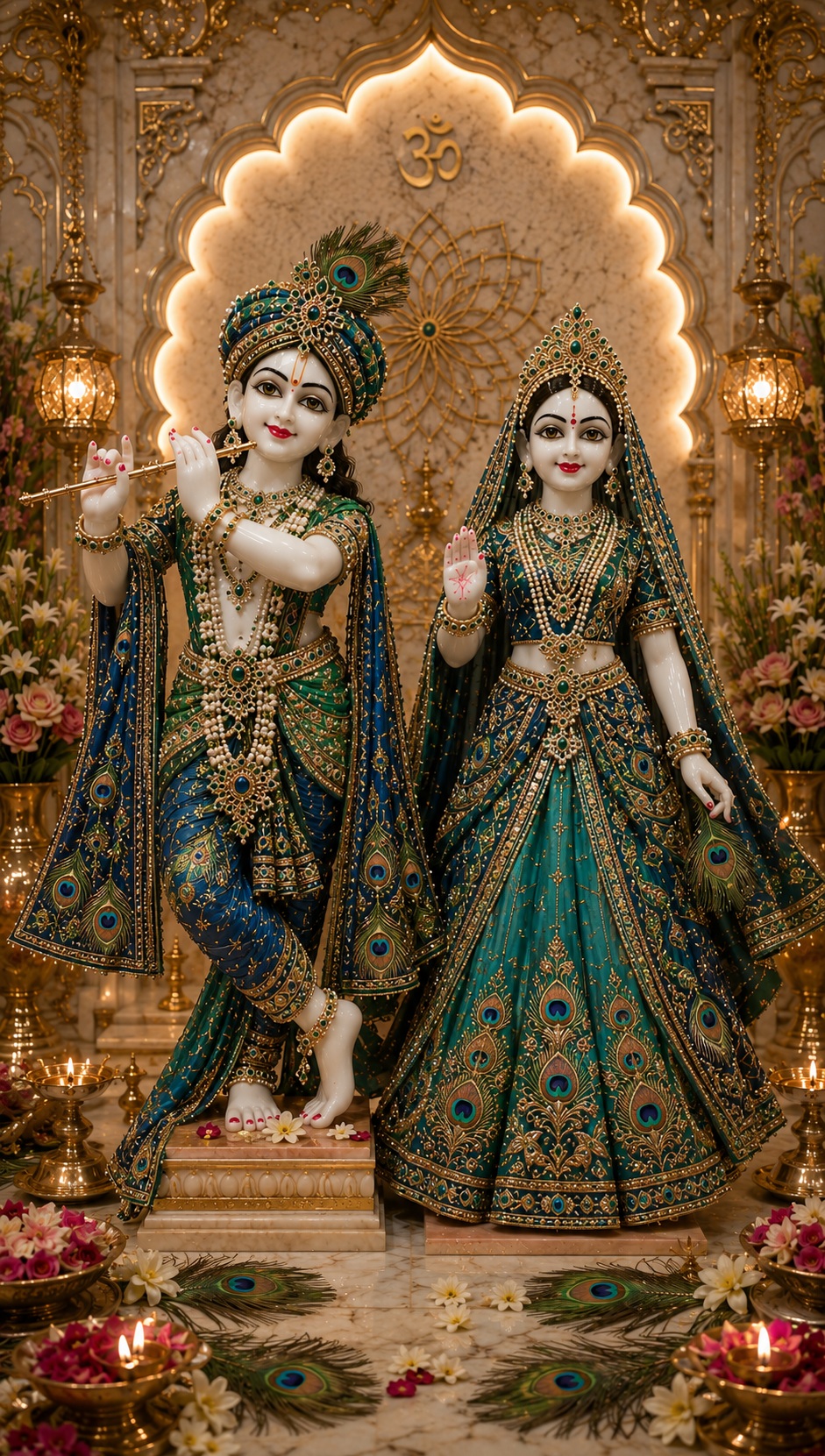
Radha Rani Ji Poshak Options for Janmashtami
Each type of Radha Rani Ji poshak creates a different quality in the Yugal Jodi presentation:
Handcrafted Radha Rani Lehenga The most elaborate and most visually substantial option. A handcrafted Radha Rani lehenga in heavy silk or Banarasi, with original handwork embroidery, creates the most complete Yugal Jodi presentation when paired with a similarly elaborate Kanha Ji Janmashtami poshak. Reserved for the most significant occasions, Janmashtami, Diwali, Annakut.
Radha Rani Heavy Poshak The standard premium option for major festivals. Less structure than a lehenga, but equal in fabric weight and embellishment level. More widely available and more accessible than full handwork lehenga, while still appropriate for Janmashtami Yugal Jodi.
Traditional Radha Rani Chunri and Chandrika The most traditional silhouette, a chunri (drape) with a chandrika (veil) that creates a graceful, classical appearance. This is the option for devotees who prefer a more understated, traditional Yugal Jodi presentation. It pairs naturally with a Kanha Ji poshak of moderate embellishment rather than the heaviest festival options.
Radha Rani Designer Red Velvet Dress For winter Janmashtami setups, or for devotees wanting a distinctly contemporary Yugal Jodi, a Radha Rani designer red velvet dress creates a striking visual paired with Kanha Ji in coordinating gold or ivory. Most effective for large setups where bold visual contrast between the two figures is appropriate.
For Sharad Poornima specifically, the Radha Rani white and golden poshak is the most traditional choice, but for Janmashtami, richer and warmer tones serve the occasion better.
Sizing for Yugal Jodi, Measuring Radha Rani Ji and Kanha Ji Separately
This is the practical section that prevents the most common Yugal Jodi ordering mistake.
Radha Rani Ji and Kanha Ji are almost always different sizes, even when they appear similar in height. In most Yugal Jodi setups:
- Radha Rani Ji is typically 1 to 2 sizes taller than Kanha Ji
- Their respective widths may also differ
- A single "matching set" ordered in one size will not fit both correctly
The correct approach: measure each separately, height in inches from feet to head, not including the mukut, and order Radha Rani Ji poshak and Kanha Ji poshak in their respective sizes.
For complete sizing guidance including all sizes from 0 to 10, our Laddu Gopal poshak size chart covers the measurement process in full detail, including the Radha Rani pairing size guide.
Mukut and Accessories for Yugal Jodi
The coordination extends beyond poshak to the mukut and jewellery of both Radha Rani Ji and Kanha Ji.
Mukut coordination: Both should be in the same metal tone, if Kanha Ji wears a gold-tone mukut, Radha Rani Ji's should also be gold-tone. Mixing metal tones across a Yugal Jodi setup creates visual inconsistency.
Jewellery weight: Match the elaborateness. If Kanha Ji has a full jewellery set for Janmashtami, Radha Rani Ji should also have a complete set, haar, kundal, kangan, at a similar level of detail.
Bansuri: Kanha Ji's bansuri remains one of the most important accessories in a Yugal Jodi presentation. Radha Rani Ji is traditionally presented with hands in a gesture of devotion. These complementary hand elements complete the iconographic story of the pairing.
For complete guidance on Kanha Ji's Janmashtami accessories including mukut, bansuri, and jewellery, our Janmashtami shringar accessories guide covers each element in detail.
Creating the Yugal Jodi Setup, Singhasan and Space
The singhasan and the space between Radha Rani Ji and Kanha Ji matters as much as the poshak itself.
Positioning: In traditional Yugal Jodi setups, Radha Rani Ji stands or is seated to Kanha Ji's left from the viewer's perspective. This positioning is followed across most Vaishnava traditions.
Singhasan: Ideally a single singhasan designed for two figures, or two closely placed singhasan of matching height and style. A significant height difference between the two singhasan creates a visual imbalance even when the poshak is perfectly coordinated.
Space and framing: The space between the two figures should be close enough to create a sense of togetherness, too much separation makes the darshan feel like two individual shringar setups rather than a Yugal Jodi.
The Most Popular Radha Krishna Dress for Janmashtami
For devotees wondering where to begin, here is what most Yugal Jodi households choose for Janmashtami:
- Kanha Ji: Janmashtami special heavy zari Laddu Gopal dress in deep yellow or midnight blue, Banarasi silk base, sized to measurement
- Radha Rani Ji: Radha Rani heavy poshak or handcrafted Radha Rani lehenga in coordinating saffron or rose pink, same fabric weight
- Both: Gold-tone mukut, matching jewellery level, fresh marigold and jasmine haar for both
This combination is the most widely observed Yugal Jodi Janmashtami presentation across devout households in North India, because it is both theologically appropriate and visually coherent.
Creating One Unified Darshan, Beyond the Poshak
A Yugal Jodi Janmashtami shringar that truly works extends beyond the poshak to every element of the mandir space.
Backdrop: A single fabric backdrop placed behind both Thakur Ji should be wide enough to frame both singhasan positions. The backdrop color should complement both poshaks, a gold or ivory backdrop works with almost any Yugal Jodi color combination.
Flowers: For Phool Bangla or fresh flower decoration, the arrangement should encircle both figures as one unit. A flower haar for each is beautiful, but a shared flower arrangement that frames both together creates a stronger sense of unified darshan. For a complete Phool Bangla guide, our Janmashtami Phool Bangla guide covers this in full.
Diyas: Place diyas symmetrically around the entire Yugal Jodi singhasan rather than individually around each figure. The light should illuminate the pair as a whole.
Photography: The most beautiful Yugal Jodi Janmashtami photographs are taken from a distance that shows both figures clearly in one frame, not close-ups of each individually. The pair is the subject, and the photograph should honor that.
For a complete Janmashtami mandir decoration guide, our Janmashtami decoration guide covers every element in detail.
Divyambar's Seva Insight In Yugal Jodi shringar, the most important decision is not which poshak is more beautiful, it is which poshak creates the most beautiful pair. Sometimes that means choosing a slightly simpler design for Kanha Ji so that the coordination with Radha Rani Ji reads more clearly. The pair is always the subject. Each poshak is in service of it.
At Divyambar, Yugal Jodi collections are developed together rather than independently. Color palettes, embroidery density, border designs, and motifs are planned as a pair, so when the two poshaks arrive and are dressed together, the darshan feels designed rather than assembled. This approach to Yugal Jodi design is what distinguishes a truly coordinated Radha Krishna poshak from two separately beautiful pieces placed side by side.
When preparing your Kanhaji Darbar or Yugal Jodi setup this Janmashtami, explore our Laddu Gopal dress collection for handcrafted poshak options sized precisely to your Kanha Ji's specific measurement, designed to serve the complete Yugal Jodi presentation.
Continue Your Janmashtami Preparation
- Janmashtami Laddu Gopal Dress 2026, Complete Guide
- Janmashtami Shringar, Mukut, Jewellery & Accessories Guide
- Laddu Gopal Dress for Janmashtami by Size 0 to 10
- Janmashtami Decoration Ideas for Laddu Gopal at Home
Frequently Asked Questions
What is Yugal Jodi dress for Janmashtami?
Yugal Jodi dress refers to a coordinated Radha Krishna poshak for both Radha Rani Ji and Kanha Ji worn together for Janmashtami. A true matching Radha Krishna dress means both poshaks share complementary colors, matching fabric weight, and the same level of embellishment, creating a unified devotional presentation.
How do I coordinate Radha Krishna poshak for Janmashtami?
Choose complementary rather than identical colors, deep yellow for Kanha Ji with saffron for Radha Rani Ji, or midnight blue with rose pink. Match fabric weight, if Kanha Ji wears heavy zari silk, Radha Rani Ji's poshak should also be in a heavy fabric. Measure each separately, as they are almost always different sizes.
Which poshak is best for Radha Rani Ji on Janmashtami?
A handcrafted Radha Rani lehenga or Radha Rani heavy poshak in complementary color to Kanha Ji's poshak is the most appropriate choice for Janmashtami. The Traditional Radha Rani Chunri and Chandrika is a graceful alternative for a more understated presentation. The Radha Rani white and golden poshak is traditionally associated with Sharad Poornima rather than Janmashtami.
Should Radha Rani Ji and Kanha Ji wear the same color poshak?
Generally no. Complementary colors create a more beautiful and complete Yugal Jodi darshan than identical colors. The eye should be able to see both Radha Rani Ji and Kanha Ji clearly, and complementary tones allow each to be distinct while the pair still feels unified.
How do I size poshak for a Yugal Jodi setup?
Measure each separately, height in inches from feet to head, not including the mukut. Radha Rani Ji is typically 1–2 sizes larger than Kanha Ji in the same setup. Order each poshak in its correct size rather than assuming a single "set" size will fit both.
What is the most popular Radha Krishna dress for Janmashtami?
The most commonly chosen Yugal Jodi combination is: Kanha Ji in heavy zari Laddu Gopal dress in deep yellow or midnight blue, and Radha Rani Ji in Radha Rani heavy poshak or handcrafted Radha Rani lehenga in complementary saffron or rose pink. Both in heavy fabric, gold-tone mukut, and matching jewellery level.
Radha Krishna poshak Janmashtami ke liye kaise coordinate karein?
Dono ke liye complementary rang chunein, matching rang avoid karein. Kanha Ji yellow poshak mein toh Radha Rani Ji saffron ya coral mein achhi lagti hain. Dono ke fabric ka weight match karein, dono heavy ya dono light. Alag-alag measure karein kyunki dono ka size almost hamesha alag hota hai. Yugal Jodi shringar mein sabse important hai ki dono milkar ek complete darshan banate ho, alag-alag nahi.