Janmashtami Decoration Ideas for Laddu Gopal at Home — Complete Mandir Setup Guide
A complete Janmashtami decoration guide for Laddu Gopal at home — flowers, diyas, jhula, backdrop, rangoli, and how to create a beautiful mandir setup for Kanha Ji's birthday whether you have a large puja room or a small apartment shelf.
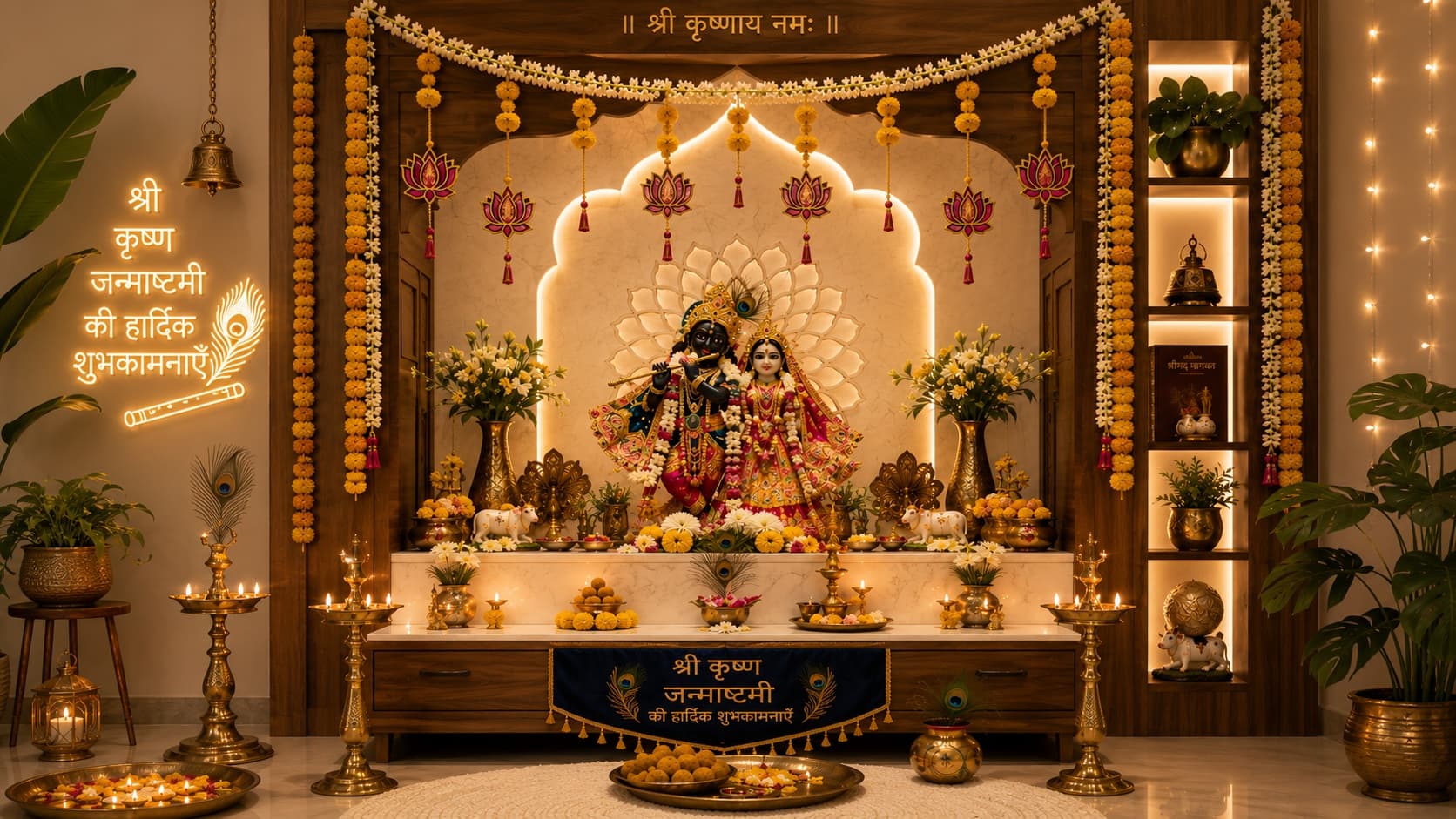 Janmashtami Decoration Ideas for Laddu Gopal at Home — Complete Mandir Setup Guide
Something happens in a home when it is decorated for Janmashtami.
The air changes. The mandir becomes a destination rather than a corner. People who normally just fold their hands in passing find themselves stopping, smiling, taking photographs, and sitting a little longer.
That is the purpose of Janmashtami decoration — not simply making the mandir look beautiful, but making it feel like a birthday celebration. Because that is what it is. Kanha Ji's janmadin. And like every birthday worth remembering, the way the space is prepared reflects how much the occasion is valued.
This guide covers every element of Janmashtami decoration for Laddu Gopal at home,from flowers and diyas to jhula, backdrop, and rangoli,with practical advice for every kind of setup, whether you have a large dedicated puja room or a single mandir shelf in an apartment.
This guide reflects Janmashtami decoration practices followed by devout households across North India, with specific reference to traditions from Vrindavan and Mathura where Janmashtami has always been both a spiritual and deeply aesthetic occasion. Last updated August 2026.
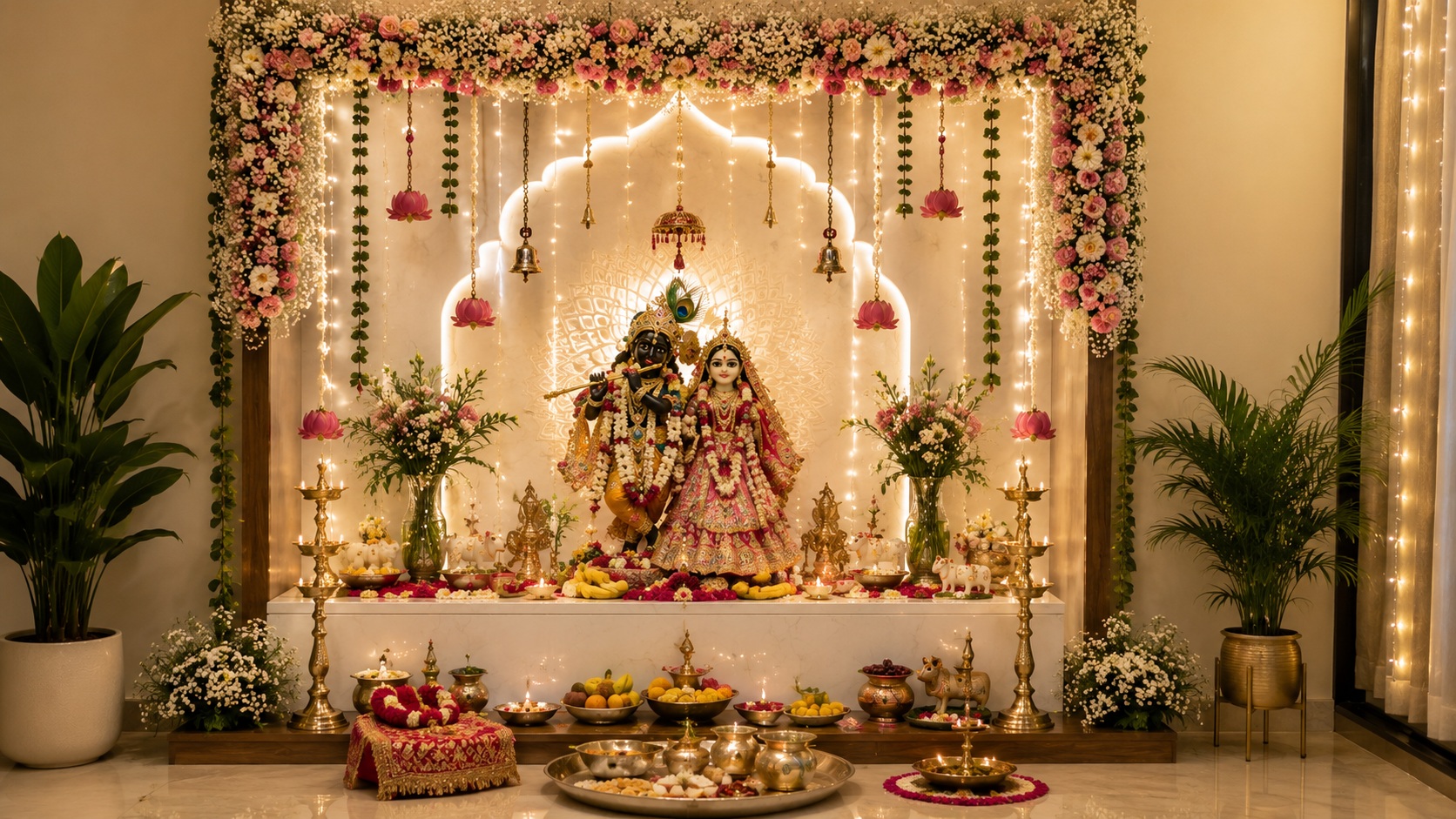
What is Janmashtami decoration for Laddu Gopal? Janmashtami decoration for Laddu Gopal refers to the complete visual and sensory preparation of the home mandir for Kanha Ji's birthday,including flower arrangements, diya setup, jhula placement, fabric backdrop, and rangoli. The goal is to create a space that feels like a genuine celebration of the divine rather than a standard daily mandir setup.
Quick Reference,Janmashtami Decoration Checklist
- Fresh flowers: marigold strings, white jasmine, rose petals
- Diya arrangement: odd-number groupings (5, 7, 11) around the singhasan
- Jhula (swing): decorated with flowers, used for Palna ceremony
- Fabric backdrop: yellow, gold, or deep red behind the singhasan
- Rangoli: at mandir entrance or beneath the singhasan
- Poshak: the centerpiece,everything else frames it
- Photograph setup: natural morning light or diya-only midnight
Why the Decoration Around the Poshak Matters
There is a principle that experienced devotees understand intuitively: a Janmashtami decoration is only as strong as its centerpiece. And the centerpiece is always Kanha Ji,specifically, the Janmashtami dress He is wearing.
This is why poshak and decoration are not separate decisions. They are a single visual decision made from the same intention.
A deeply embroidered Janmashtami special heavy zari dress on Kanha Ji, placed against a plain white wall with no backdrop and a single diya, is a beautiful idol in an empty space. The same poshak against a gold silk backdrop, surrounded by fresh marigolds, with seven diyas symmetrically arranged,that is a darshan people photograph and remember.
The poshak you have chosen, or plan to choose, should guide the decoration around it. If you have not yet finalized the dress, our complete Janmashtami poshak guide covers every category in detail.
"Decoration is the frame. The poshak is the painting. But even the most beautiful painting benefits from the right frame."
Daily Mandir vs Janmashtami Decoration,What Changes
| Element | Daily Setup | Janmashtami Setup |
|---|---|---|
| Diyas | One or two | 5, 7, or 11 in symmetrical arrangement |
| Poshak | Daily cotton or soft fabric | Heavy zari, handmade, or designer festival dress |
| Flowers | Single flower or none | Marigold canopy, jasmine, rose petals |
| Backdrop | Painted wall | Silk or brocade fabric in festival color |
| Jhula | Not typically used | Decorated swing for Palna ceremony |
| Fragrance | Standard incense | Jasmine, fresh flowers, ghee diya together |
| Accessories | Daily mukut | Full jewellery set, bansuri, complete shringar |
Understanding this difference helps devotees plan their preparation. Janmashtami decoration is not just "more" of what already exists,it is a qualitatively different presentation, prepared with the same care the occasion deserves.
The Sensory Atmosphere of Janmashtami
Before covering individual decoration elements, something worth noting: the most powerful Janmashtami experiences are not purely visual.
As the shankh is blown and the bells begin to ring at midnight, the fragrance of jasmine mixes with the warmth of the diya flames, and the metallic thread of the Janmashtami poshak catches the shifting light,this is when the decoration achieves what no photograph can fully capture. It is an atmosphere. A complete sensory experience of the divine birthday.
When preparing your Janmashtami decoration, think about all five senses: the sight of the flowers and diyas, the fragrance of jasmine and ghee, the sound of the shankh and bhajans, the warmth of the flame, and the texture of the handmade Kanha Ji poshak when you dress Him with care. Each element contributes to something larger than its individual effect.
Element 1,Flowers
Fresh flowers are the single most transformative decoration element for Janmashtami, and the one where even a small effort creates the most visible impact.
Marigold,The Essential Janmashtami Flower
Marigold has long been associated with auspicious celebrations across many Hindu traditions and is widely used in Krishna temples and Vaishnava devotional contexts. Its warm golden-orange color also mirrors the pitambar (yellow) traditionally associated with Krishna's own divine form.
Marigold strings hung above and around the mandir alcove are the most traditional and most widely used Janmashtami decoration in Indian homes. The warm golden-orange against a deep-colored fabric backdrop or a yellow poshak is a combination that appears in temple mandir decorations and home setups alike.
For a complete marigold setup: string marigolds across the top of the mandir opening, allow them to drape down at the sides, and scatter loose petals on the singhasan base. Even this basic arrangement changes the visual of the entire mandir.
White Jasmine,The Fragrant Offering
Jasmine holds a special place in Vaishnava tradition because of its association with purity and devotion,its fragrance is considered a natural form of offering to the divine, present in seva even when no incense is lit. A fresh jasmine haar placed around the singhasan, or jasmine strings woven into the marigold backdrop, adds both visual elegance and the kind of fragrance that makes the evening of Janmashtami genuinely atmospheric.
Jasmine wilts faster than marigold in summer heat,prepare it as close to the evening decoration as possible, or replace it for the midnight puja.
Phool Bangla,The Traditional Flower Canopy
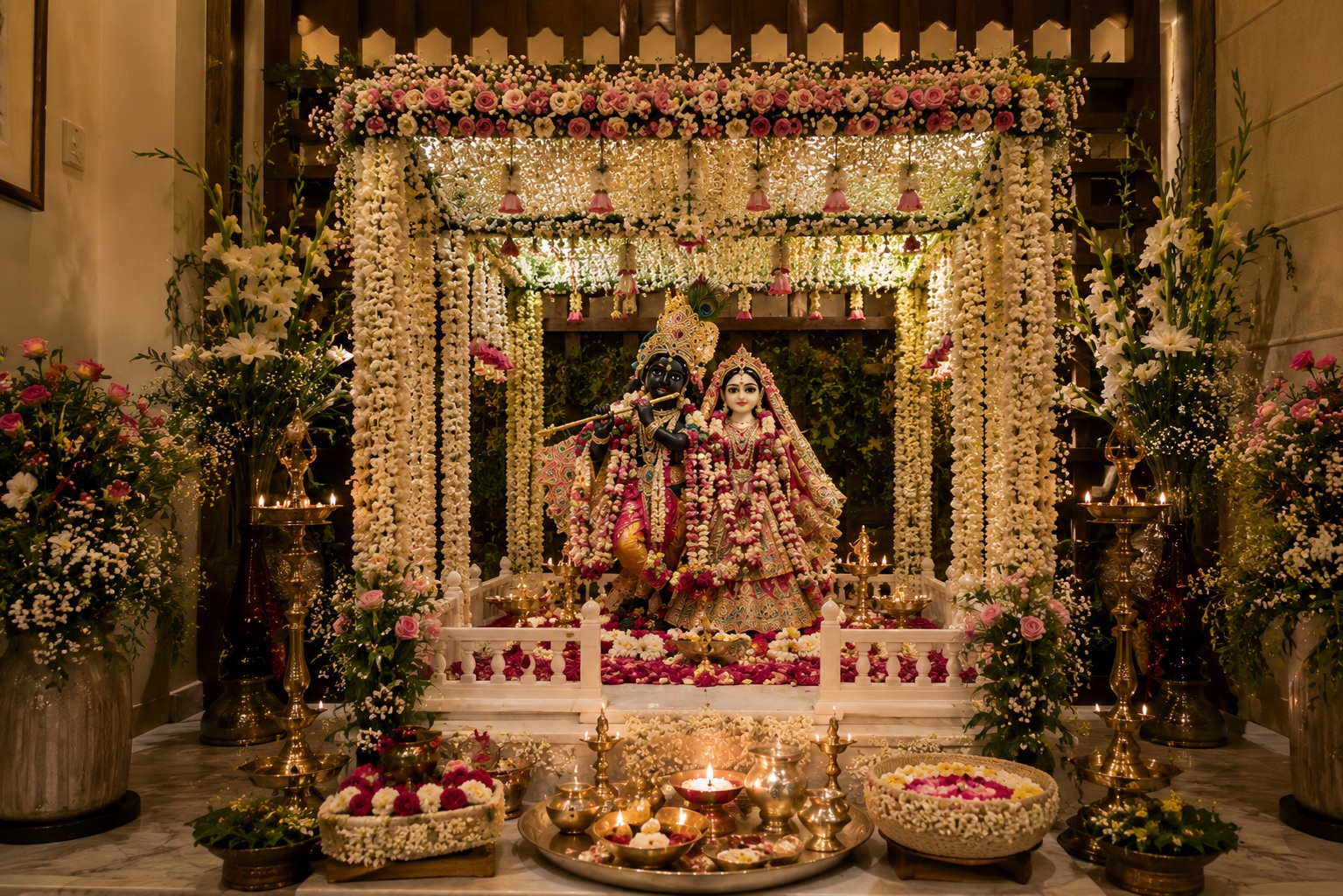
The Phool Bangla is a traditional Janmashtami decoration form,a flower canopy built above and around the idol, creating a bower-like enclosure of petals and stems. In Vrindavan's temples, Phool Bangla installations are elaborate and require skilled floristry. At home, a simplified version using marigold strings, rose petals, and jasmine is both achievable and deeply beautiful.
How to create a simple home Phool Bangla:
- Hang marigold strings horizontally across the top of the mandir opening
- Pin or tie small bunches of roses at intervals along the strings
- Allow jasmine stems to drape downward from the top arrangement
- Add loose petals to the singhasan base and surrounding shelf
This does not require professional skill,just fresh flowers and an hour of preparation.
Element 2,Diya Arrangement
Diyas are the most sacred visual element of Janmashtami decoration, and how they are arranged changes the atmosphere of the midnight puja entirely.
The odd-number principle: Traditional diya arrangements follow odd numbers,5, 7, 11, or 21 diyas. Across many Hindu devotional traditions, odd numbers are considered more auspicious than even numbers for offerings and arrangements,a practice observed widely in puja contexts, though interpretations vary by region and sampradaya. Practically, odd numbers also create natural, visually balanced groupings without the rigid symmetry that can feel institutional rather than devotional.
Arrangement around the singhasan: Place diyas symmetrically at the base level of the singhasan, with one elevated diya behind or beside the idol. For a more elaborate setup, a second row of smaller diyas on the shelf below the mandir creates depth and visual layering.
The midnight moment: For the Nishita Puja,Janmashtami 2026 falls between 12:14 AM and 1:01 AM on the night of September 4 into September 5,switch off all artificial lights. Let only the diya flames illuminate Kanha Ji. At this moment, if Kanha Ji is dressed in a handmade Kanha Ji poshak or a Janmashtami special heavy zari dress, the metallic thread work catches the diya light in a way that no photograph fully captures. This is the visual Janmashtami was made for.
Apartment note: For setups where open flames are restricted, warm LED diyas in the deepest golden color temperature available are a practical alternative. The atmosphere is largely preserved.
Element 3,Laddu Gopal Jhula Decoration
The jhula,the decorated swing,is perhaps the most emotionally resonant Janmashtami decoration tradition. The jhula holds profound significance in Vaishnava tradition because it recreates the Palna scene,the moment the infant Krishna was placed in the cradle in Gokul, celebrated as the beginning of His earthly leela. Placing Kanha Ji in a decorated swing is a symbolic reenactment of that first moment of celebration.
A small wooden or brass jhula, decorated with fresh flowers and fitted with a fabric swing seat in yellow or gold, becomes the focal point of the entire mandir on Janmashtami night.
Decorating the jhula:
- Wrap the arms of the swing with fresh marigold strings
- Add a small fabric canopy above if the structure allows,a simple square of silk in gold or yellow
- Line the swing seat with a small piece of soft fabric, complementing the Janmashtami poshak color
- Place a few jasmine flowers within the seat before placing Kanha Ji
When Kanha Ji is placed in His Janmashtami dress inside the decorated jhula at midnight, that becomes the image devotees carry with them through the year.
If you do not currently have a jhula, this is the single addition that most transforms a home Janmashtami setup. Even a simple small wooden swing, properly decorated, changes both the visual and the emotional quality of the occasion.
Element 4,Fabric Backdrop
A fabric backdrop placed behind the singhasan is a simple, low-cost, and visually powerful decoration choice,consistently underestimated by devotees preparing for Janmashtami.
A clean piece of silk, brocade, or cotton in yellow, deep gold, red, or peacock green hung behind the singhasan creates an immediate visual frame for Kanha Ji and His poshak.
Why this matters for photographs: Every devotee photographs Kanha Ji on Janmashtami. A fabric backdrop makes every photograph look deliberate,as if the space was thoughtfully prepared. The Laddu Gopal dress reads more clearly against the backdrop color. The overall presentation looks intentional rather than incidental.
Color choice: Match the backdrop to the poshak through contrast rather than matching. A yellow pitambar poshak photographs beautifully against deep gold or peacock green. A midnight blue Kanha Ji dress reads clearly against ivory or cream fabric. Contrast almost always works better than exact color matching for backdrop purposes.
Element 5,Rangoli
Rangoli placed at the entrance to the puja room or beneath the mandir shelf in Kanha Ji's traditional colors,yellow, blue, peacock green,is both a devotional tradition and a visual preparation of the celebration space.
Color palette for Janmashtami rangoli: Yellow, blue, orange, and white are the most traditional Janmashtami rangoli colors. A peacock motif is particularly appropriate,the peacock feather (mor pankh) is one of Kanha Ji's most recognizable symbols, representing purity and the divine nature of creation. Using it in the rangoli beneath the mandir creates a visual connection between the floor decoration and the shringar of the deity above.
For apartment settings: A small rangoli plate placed in front of the singhasan achieves the same devotional and visual purpose without requiring floor space.
Element 6,Natural Greenery
An element that many devotees overlook,and that transforms the entrance to a Janmashtami mandir with almost no effort,is fresh natural greenery.
Mango leaves, banana leaves, and Ashoka leaves have been used in Hindu celebration and temple decoration for centuries. Mango leaf torans hung across the doorframe of the puja room or mandir area serve as a traditional invitation to auspiciousness,their deep green color also creates a natural visual frame for the flower decoration inside.
A simple mango leaf toran above the mandir opening costs almost nothing and takes five minutes to prepare. In the context of Janmashtami, where Vrindavan's own trees and forests are inseparable from Kanha Ji's leela, fresh greenery carries a particular resonance,it brings a small piece of the natural world into the celebration at home.
Janmashtami Decoration by Space Type
Large Dedicated Puja Room
If you have a dedicated puja room, Janmashtami decoration can extend beyond the singhasan:
- Floor rangoli at the entrance
- Marigold strings across the doorframe
- Multiple diya arrangements at different heights
- Full Phool Bangla above the main deity setup
- Fabric draping on walls in festival colors
- A decorated jhula as the centrepiece
Small Apartment Mandir Shelf
For a single shelf or compact mandir unit, choose one or two elements and execute them with full attention:
| Space | Single Best Addition | Second Best Addition |
|---|---|---|
| Shelf mandir | Fabric backdrop | Fresh jasmine haar |
| Small alcove | Marigold drape above | 5-diya arrangement |
| Cabinet mandir | 5-diya arrangement | Rose petals on base |
| Compact jhula setup | Decorated jhula | Marigold wrap |
Small does not mean less. Some of the most beautiful Janmashtami setups in devout homes are compact,because every element was chosen with intention.
For Kanhaji Darbar and Yugal Jodi Setups
For households keeping both Radha Rani and Kanha Ji,as a Kanhaji Darbar or Yugal Jodi setup,the decoration extends naturally to frame both idols as a complete presentation.
The fabric backdrop should be wide enough to frame both singhasan positions. Flower elements should be arranged to encircle both idols without separating them. And the poshak coordination matters even more in a paired setup,a handcrafted Radha Rani lehenga or Traditional Radha Rani Chunri and Chandrika should complement the Kanha Ji dress in both color tone and fabric weight.
The decoration creates the world in which Radha and Kanha appear together. Treating it as one unified visual decision, rather than two separate idol setups, creates the most harmonious result.
The Poshak Is the Decoration
A beautiful Janmashtami celebration is never measured by the size of the decoration. Even a small mandir prepared with sincerity,a fresh flower, a single diya, a thoughtfully chosen poshak, and genuine seva,can become deeply meaningful. The scale matters far less than the intention behind it.
Divyambar's Seva Insight The most memorable Janmashtami decorations are rarely the most expensive. They are the ones where every element,the poshak, the flowers, the diya, and the bhog,feels thoughtfully chosen and prepared with devotion. When each piece is selected with care rather than convenience, the mandir reflects what Janmashtami actually is: not a performance, but an offering.
Every decoration element exists to do one thing: present Kanha Ji at His most beautiful.
Which means the Janmashtami dress you choose is not a separate decision from the decoration you prepare. It is the most important decorative decision of the entire celebration.
No amount of fresh marigold, no number of diyas, no carefully prepared backdrop replaces the experience of Kanha Ji in a genuinely beautiful, quality Janmashtami special poshak. The decoration amplifies the poshak. The poshak justifies the decoration.
If you are still choosing this year's Janmashtami poshak, we have also created a collection designed specifically for this celebration,handcrafted options across multiple sizes and styles, each considered with the same care that goes into everything else you are preparing.
Browse our Laddu Gopal dress collection.
Related Guides
- Janmashtami Laddu Gopal Dress 2026,Complete Guide
- Janmashtami Special Dress,Heavy Zari, Handmade & Designer Ideas
- Janmashtami Shringar,Mukut, Jewellery & Accessories Guide
- Laddu Gopal Dress for Janmashtami by Size 0 to 10
Frequently Asked Questions
How do I decorate my home mandir for Janmashtami?
The core Janmashtami decoration elements are: fresh flowers (marigold strings and jasmine), symmetrically arranged diyas in odd-number groupings, a fabric backdrop behind the singhasan, and a decorated jhula for the Palna ceremony. For small apartment setups, one or two of these elements done well creates more visual impact than all of them done without intention.
Which flowers are best for Janmashtami Laddu Gopal decoration?
Marigold and white jasmine are the two most traditional Janmashtami flowers for Laddu Gopal decoration. Marigold strings for draping and canopy, jasmine for fragrance and haar. Rose petals scattered on the singhasan base add further beauty. All three together create the most complete traditional flower arrangement.
What is a Phool Bangla and how do I make one at home?
A Phool Bangla is a traditional flower canopy built above and around the deity idol for Janmashtami. At home, a simplified version uses marigold strings hung horizontally across the top of the mandir, rose bunches tied at intervals, jasmine stems draping downward, and loose petals scattered on the singhasan base. No professional skill is required,just fresh flowers and about an hour of preparation.
How should I arrange diyas for Janmashtami?
Follow the odd-number principle,5, 7, or 11 diyas arranged symmetrically at the base of the singhasan. For the midnight Nishita Puja on September 4-5, 2026, switch off all artificial lights and let only the diya flames illuminate Kanha Ji. A heavy zari Janmashtami poshak catches diya light in a way no other light source replicates.
Do I need a jhula for Janmashtami decoration?
A jhula is not strictly required, but it is the most emotionally resonant Janmashtami decoration element for Laddu Gopal. It references the traditional Palna ceremony and becomes the visual focal point of the midnight celebration. Even a simple wooden jhula decorated with fresh marigolds and jasmine transforms the Janmashtami mandir setup significantly.
How do I decorate for Janmashtami in a small apartment?
Choose one or two elements and execute them well. The most impactful for small spaces are: a fabric backdrop behind the idol (immediate visual upgrade), fresh jasmine around the singhasan (fragrance fills the room), and three to five diyas arranged symmetrically (transforms the midnight puja atmosphere).
Janmashtami decoration mein sabse important kya hota hai?
Sabse important hai Kanha Ji ka Janmashtami poshak,decoration uski frame hai, poshak painting hai. Decoration mein sabse zyada impact karta hai: fresh marigold aur jasmine, diya arrangement, aur fabric backdrop. Agar ek hi cheez karni ho, woh hai jhula,Palna ceremony ka symbol, jo poore mandir setup ko transform kar deta hai. Baki sab uske aaround fit hota hai.