How to Create a Janmashtami Phool Bangla for Laddu Gopal at Home — Complete Flower Shringar Guide
A complete guide to Janmashtami Phool Bangla for Laddu Gopal — what it is, which flowers are used, how to create a flower poshak and mandir decoration at home, and why this tradition holds a special place in Vaishnava seva.
 How to Create a Janmashtami Phool Bangla for Laddu Gopal at Home — Complete Flower Shringar Guide
There is a form of shringar that requires no silk, no zari, no embroidery thread.
No fabric at all.
Just flowers.
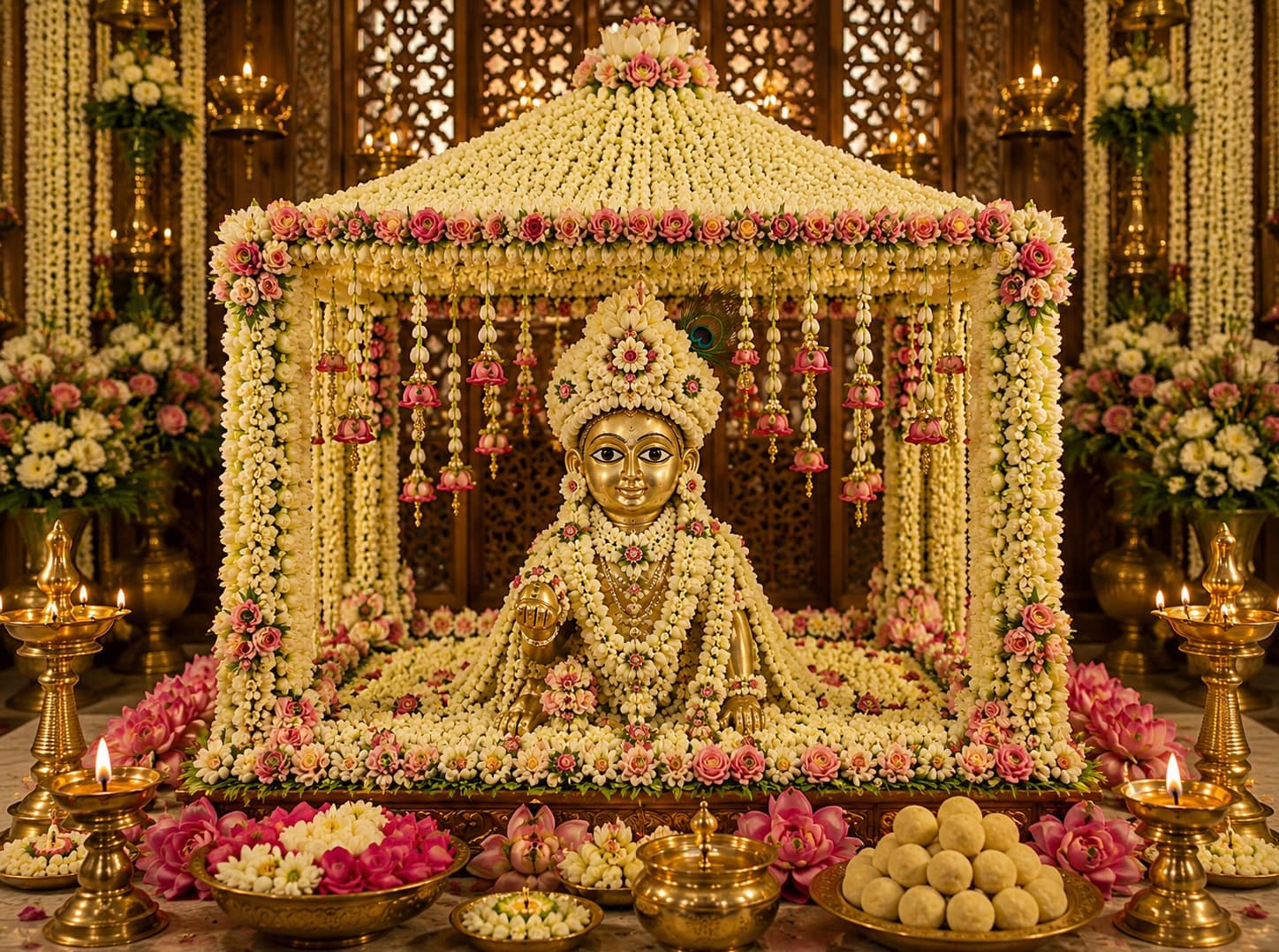
The Phool Bangla shringar,in which Laddu Gopal or Kanha Ji is dressed entirely in fresh flowers, and the mandir around Him is transformed into a garden bower,is one of the most ancient and most beautiful Janmashtami traditions in Vaishnava devotion. In the major temples of Vrindavan, particularly Banke Bihari and Radha Raman, the Phool Bangla darshan draws thousands of devotees specifically because of how extraordinary it looks,and how different it feels from every other form of shringar.
For home devotees, Phool Bangla can feel like something reserved for temples. It is not. A thoughtfully arranged flower shringar at home, even at a modest scale, creates a darshan experience that no fabric poshak alone can replicate.
This guide covers everything about Janmashtami Phool Bangla for Laddu Gopal,what the tradition is, which flowers are used and why, how to create a flower poshak on your laddu gopal ji, how to build the mandir decoration around it, and what the experience of this particular shringar offers that is genuinely different from a fabric Janmashtami dress.
This guide draws from Phool Bangla traditions practiced in Vrindavan and Mathura temples, as well as in devout households where this form of shringar has been maintained for generations. Last updated August 2026.
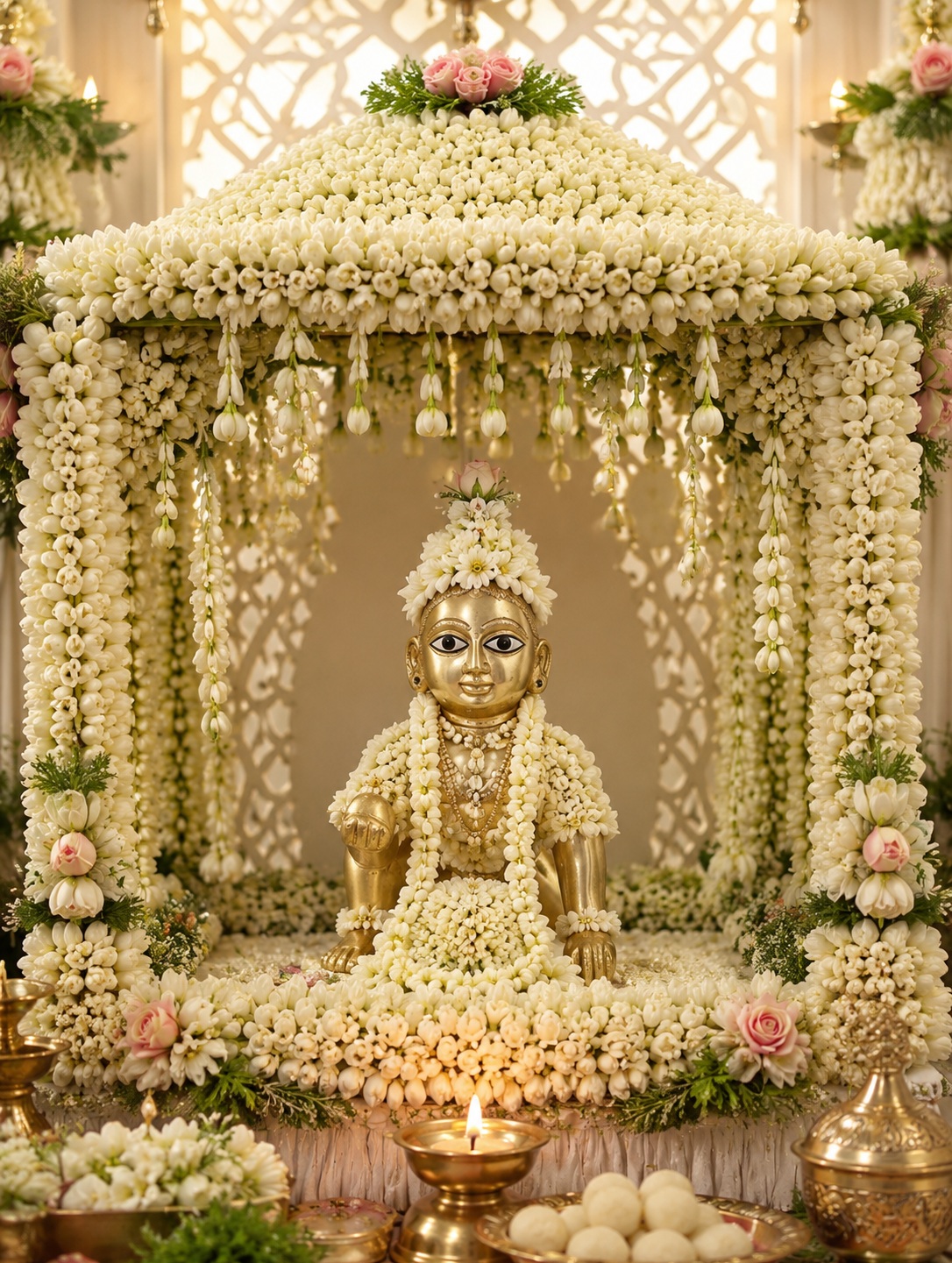
What is Phool Bangla shringar for Laddu Gopal? Phool Bangla is a form of deity shringar in which the laddu gopal ji is dressed using fresh flowers rather than fabric poshak, and the surrounding mandir space is decorated to create a complete bower or garden-like setting. For Laddu Gopal, this means the regular Kanha Ji poshak or Laddu Gopal dress is temporarily replaced with a flower arrangement that mimics a garment,using roses, jasmine, marigold, and other devotionally appropriate flowers arranged directly around the laddu gopal ji.
Quick Reference,Janmashtami Phool Bangla Essentials
- Core flowers: Rose (any color), white jasmine, marigold, champa
- Structure: Flower poshak (laddu gopal ji), canopy (above), singhasan decoration (base), toran (entrance)
- Timing: Best prepared within 2–3 hours of the Janmashtami celebration
- Replaces: Fabric poshak for this specific occasion only
- Pairs with: Mukut, bansuri, and jewellery as usual
- Tradition: Practiced in major Vrindavan temples on specific dates including Janmashtami
Why Phool Bangla Is a Distinct Form of Shringar
The first thing to understand about Phool Bangla is that it is not simply decoration around the laddu gopal ji. It is shringar,the act of dressing and adorning,using flowers as the primary medium.
In a standard Janmashtami preparation, a devotee chooses a Janmashtami special dress or handmade Kanha Ji poshak in fabric, and then decorates the mandir around it with fresh flowers. In Phool Bangla, the relationship is reversed. The flowers are the poshak. The fabric dress is set aside.
This distinction matters because it changes the nature of the preparation itself. Phool Bangla requires the same quality of intention as choosing a premium Laddu Gopal dress,but instead of sourcing fabric and embroidery, you are sourcing and arranging the right flowers with the same care a karigar brings to handwork.
The result, when done with genuine attention, is a darshan that feels uniquely alive. A fabric poshak looks the same at midnight as it did in the morning. A Phool Bangla shringar,fresh flowers at the time of Nishita Puja, their fragrance filling the room, their petals still dewy,creates an atmosphere that is simply unrepeatable.
"Many devotees in the Vrindavan tradition see flowers as a natural expression of Krishna seva,reflecting the forests, gardens, and riverbanks associated with His leela. In Phool Bangla, that connection is made physical."
Why Flowers Have Always Been Part of Krishna Seva
Before covering which flowers to use and how to arrange them, it is worth understanding why flowers hold such a specific place in Vaishnava devotion,and why Phool Bangla exists as a shringar form at all.
In many devotional traditions, flowers are offered because they represent a particular quality that other offerings do not: impermanence. A flower blooms, offers its fragrance and beauty, and then fades. It cannot be stored for next week's seva. It must be offered fresh, which means every Phool Bangla flower shringar requires a devotee to return to the act of seva with fresh attention.
For many practitioners, this makes flowers a uniquely personal expression of devotion. A heavy zari Laddu Gopal dress or a handmade Kanha Ji poshak is sourced once and used many times,its craftsmanship is a one-time offering that continues to serve. A flower poshak for deity shringar must be recreated completely each time, making every Phool Bangla preparation its own complete act of love.
This is why the tradition exists alongside fabric poshak rather than replacing it. Both are offerings. They simply carry different qualities of intention.
Which Flowers Are Used in Phool Bangla
Not all flowers are equally appropriate for deity shringar. The selection is guided by tradition, fragrance, visual effect, and how well each flower holds its shape when arranged around an laddu gopal ji.
Rose,The Primary Flower
Rose is the most widely used flower for Phool Bangla across all traditions. Its petals are substantial enough to create a poshak-like layered effect around the laddu gopal ji, its fragrance is considered one of the most appropriate for deity offering, and it is available in colors that match different Janmashtami color intentions,Because rose petals hold their shape well, they are also easier for beginners creating their first home Phool Bangla.
For Janmashtami specifically: Red and deep pink roses create a rich, festive feel. White roses with yellow rose accents mirror the pitambar tradition. A combination of white, yellow, and orange roses together is one of the most beautiful Phool Bangla color palettes for Kanha Ji's birthday.
White Jasmine,The Essential Fragrance Layer
No Phool Bangla is complete without jasmine. While jasmine does not form the structural body of the flower poshak, its role is as essential as that of zari in a fabric dress,it creates the detail, the delicacy, and the fragrance that elevates everything else.
Jasmine strings wound around the singhasan base, woven through rose arrangements, and placed as a haar around the laddu gopal ji create the olfactory atmosphere that is inseparable from Phool Bangla as an experience.
Marigold,Structure and Volume
Marigold strings provide the structural volume of Phool Bangla decoration,particularly for the canopy and mandir framing. For the laddu gopal ji itself, loose marigold petals can be used to create a base layer, with roses and jasmine placed above.
The bright orange of marigold against white or yellow roses creates a genuinely festive combination. It is also the most easily available and most affordable element, which makes it the foundation of any accessible home Phool Bangla setup.
Champa (Plumeria) and Lotus,For Those Who Can Source Them
Where available, champa flowers hold particular significance in Vaishnava tradition,their fragrance is considered deeply sacred and appropriate for deity offerings. A few champa flowers incorporated into a Phool Bangla arrangement add a dimension that most commercial flowers cannot replicate.
Lotus petals, where available, carry obvious significance for Krishna devotions and create a visual effect that is both strikingly beautiful and theologically resonant.
How to Create a Phool Bangla for Laddu Gopal at Home
Step 1,Prepare the Idol
Begin with the standard snaan (bath) for Kanha Ji. Pat dry carefully. In many Phool Bangla traditions, the flower shringar is arranged directly on the laddu gopal ji without a visible fabric poshak underneath, although some devotees use a simple cotton base for support. some devotees place a simple white cotton base beneath the flowers for structural support, which is also acceptable.
Place the mukut on the laddu gopal ji first,the Phool Bangla is built around the mukut, not over it.
Step 2,Create the Base Layer
Begin with larger flowers and petals to create the foundational layer of the flower poshak. This is similar to the role that fabric plays in a Laddu Gopal dress,it creates the shape and volume before the detail elements are added.
Loose marigold petals arranged in a circular pattern around the base of the laddu gopal ji, extending outward from the singhasan, create the foundation. This is also where rose petals can be used generously.
Step 3,Build the Flower Poshak Around the Idol
Using small rose bunches, carefully arrange flowers around the body of the laddu gopal ji to create the appearance of a garment. Small roses work better than large ones for this,they can be nestled closely together to create a dense, poshak-like layering.
If the laddu gopal ji is a standard size 3 or size 4 Laddu Gopal, approximately 15–25 roses are typically needed for the flower poshak body, depending on their size.
The arrangement does not need to be perfectly uniform,slight natural variation in a flower shringar is part of its beauty, in the same way that slight variation in hand embroidery distinguishes it from machine work.
Step 4,Add Jasmine Details
Jasmine strings are woven around the rose arrangement to add fineness and fragrance. Think of this as the embroidery layer of the flower poshak,the detail that elevates the overall appearance from generous to refined.
A jasmine haar placed directly around the laddu gopal ji's neck completes this layer.
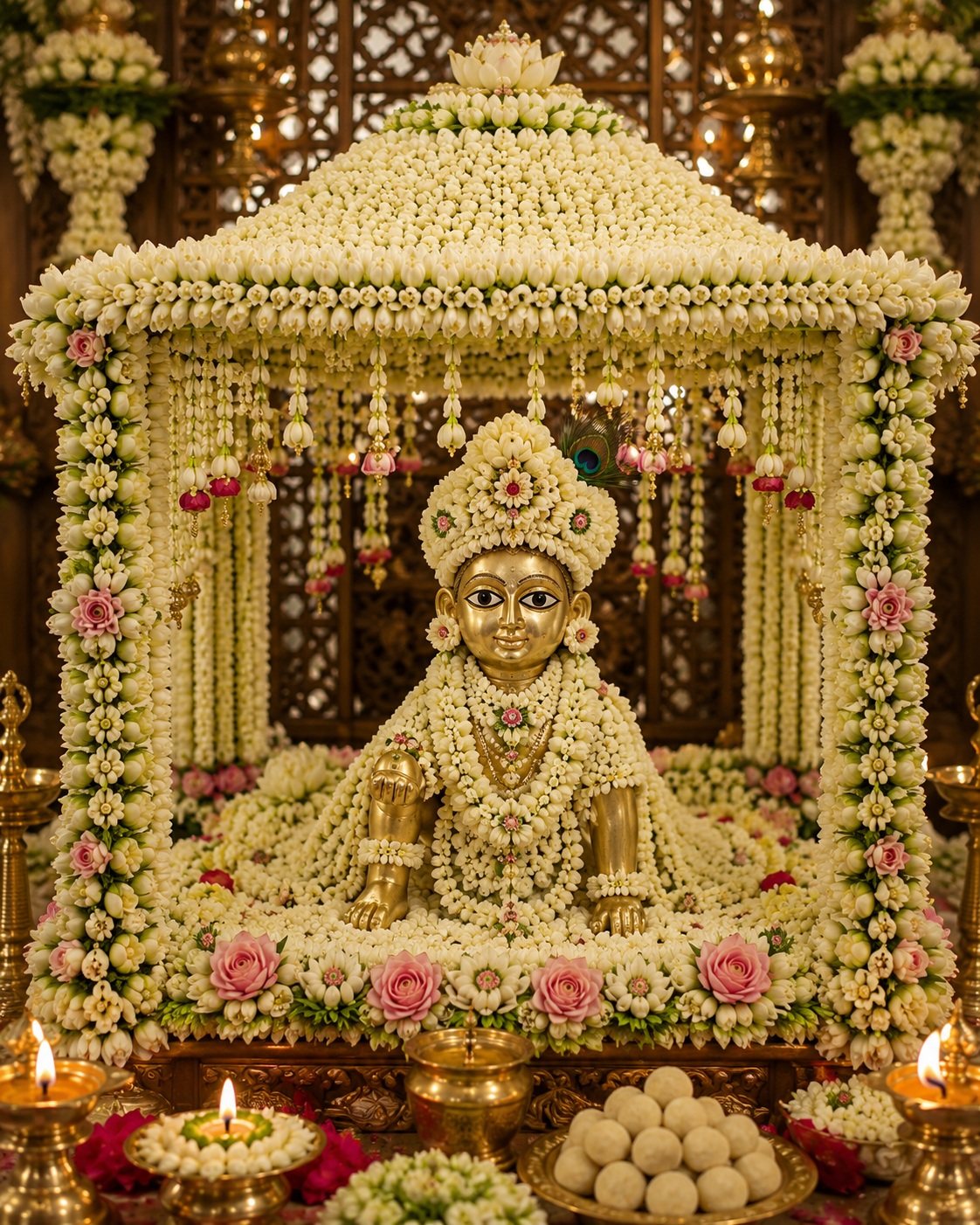
Step 5,Build the Canopy and Mandir Frame
The Phool Bangla extends beyond the laddu gopal ji to the entire mandir space. Once the laddu gopal ji shringar is complete, build outward:
- Marigold strings hung above the mandir opening to create the canopy
- Rose bunches placed at the edges of the singhasan
- Jasmine strings woven through the canopy structure
- Fresh petals scattered on every available surface
For a complete Phool Bangla effect, the entire visible surface of the mandir,singhasan, shelf, the space above,should be covered in flowers, creating the sense that Kanha Ji is sitting within a garden rather than in a domestic mandir.
Step 6,Timing Is Everything
Unlike a fabric Janmashtami special poshak that can be dressed on Kanha Ji in the morning and will look the same at midnight, Phool Bangla must be prepared close to the celebration. Flowers begin to wilt within a few hours, particularly in summer heat.
A home Phool Bangla does not need to match temple-scale arrangements to be meaningful. Even a handful of fresh roses and jasmine, offered with genuine care and attention, carries the same spirit of devotion as any elaborate installation. The scale matters far less than the sincerity behind it.
The ideal preparation sequence for Janmashtami Phool Bangla:
- Morning: Source all flowers fresh from the market
- Late evening (around 8–9 PM): Begin building the mandir canopy and outer decoration
- 10–11 PM: Complete the laddu gopal ji flower poshak
- Midnight (Nishita Puja): The Phool Bangla is at its freshest and most fragrant
Tips to Keep Your Phool Bangla Fresh Longer
- Keep cut flowers in water until the moment you begin arranging
- Avoid placing the mandir in direct afternoon sunlight on Janmashtami day
- Lightly mist petals with clean water after arrangement if the room is warm
- Prepare the laddu gopal ji flower poshak as close to the midnight puja as practical
- Have a small reserve of backup petals to refresh any wilted sections before the Nishita Puja
Phool Bangla and the Fabric Poshak,When to Use Which
Phool Bangla is a special-occasion shringar, not a daily practice. The relationship between Phool Bangla and a fabric Laddu Gopal dress is one of complement rather than replacement.
| Occasion | Phool Bangla | Fabric Poshak |
|---|---|---|
| Janmashtami midnight puja | Beautiful choice | Equally appropriate |
| Janmashtami morning shringar | Less practical (wilts) | Primary choice |
| Sharad Poornima | Traditional | Radha Rani white and golden poshak |
| Daily shringar | Not appropriate | Cotton or daily poshak |
| Diwali shringar | Optional addition | Primary |
| Special weekly occasions | For devoted practitioners | Primary |
Many devout households use Phool Bangla specifically for the midnight Janmashtami moment,dressing Kanha Ji in the flower shringar at 11:30 PM for the Nishita Puja, then returning to the regular handmade Kanha Ji poshak or fabric Janmashtami dress for the next morning's darshan.
Phool Bangla for Yugal Jodi,Radha Rani and Kanha Ji
For households with a Kanhaji Darbar or Yugal Jodi setup, Phool Bangla offers one of the most beautiful paired presentations of the entire devotional calendar.
Radha Rani's flower shringar in Phool Bangla traditionally uses predominantly white flowers,white roses, white jasmine, white champa,in keeping with Her traditional association with purity and the color most associated with Her divinity. This stands in visual contrast to Kanha Ji's warmer flower palette.
The combination of Radha Rani in white Phool Bangla and Kanha Ji in yellow and orange flowers, within the same decorated singhasan space, creates a Radha Krishna presentation that is genuinely extraordinary,more visually complex and emotionally evocative than even the finest Radha Rani heavy poshak or handcrafted Radha Rani lehenga in fabric.
Divyambar's Seva Insight Phool Bangla is the one form of Janmashtami shringar that cannot be purchased. Every other element,the Janmashtami poshak, the mukut, the jewellery,can be sourced and delivered. The flower shringar must be made, by hand, in the hours before the celebration. That is precisely why it carries a different quality of bhav. The effort itself is the offering.
When to Use Phool Bangla Alongside a Fabric Poshak
A common practice among devout households is to combine both:
The fabric Janmashtami dress on Kanha Ji,a premium Laddu Gopal heavy dress or handmade Kanha Ji poshak providing the base shringar,while the mandir around Him is given a full Phool Bangla decoration treatment.
This approach combines the permanence and craftsmanship of a quality Kanha Ji poshak with the freshness, fragrance, and visual richness of the Phool Bangla setting. The result is a Janmashtami darshan that is the most complete expression of both traditions.
For guidance on choosing the fabric poshak that serves as the foundation for this combined presentation, our complete Janmashtami poshak guide covers every category. For decoration elements that work alongside Phool Bangla, our Janmashtami decoration guide covers the full mandir setup.
At Divyambar, many Janmashtami collections are developed with flower shringar in mind. Color palettes, embroidery placement, and mukut combinations are planned so they harmonise naturally with fresh marigold, jasmine, and rose decorations rather than competing with them,which is why a Divyambar Janmashtami poshak looks as beautiful in photographs taken during Phool Bangla decoration as it does on its own.
If you are preparing both a Phool Bangla decoration and a fabric Janmashtami poshak for Kanha Ji this year, our Laddu Gopal dress collection has handcrafted options sized for your specific laddu gopal ji,designed to be worthy of the celebration you are creating around them.
Continue Your Janmashtami Preparation
- Janmashtami Laddu Gopal Dress 2026,Complete Guide
- Janmashtami Decoration Ideas for Laddu Gopal at Home
- Janmashtami Shringar,Mukut, Jewellery & Accessories Guide
- Janmashtami Special Dress,Heavy Zari, Handmade & Designer Ideas
Frequently Asked Questions
What is Phool Bangla shringar for Laddu Gopal?
Phool Bangla is a traditional form of deity shringar in which the laddu gopal ji is dressed using fresh flowers rather than a fabric poshak, and the surrounding mandir is decorated to create a complete flower bower. For Laddu Gopal, this means the regular Kanha Ji dress is replaced with an arrangement of roses, jasmine, marigold, and other flowers carefully arranged around the laddu gopal ji to mimic the form of a garment.
Which flowers are used for Phool Bangla for Kanha Ji?
Rose is the primary flower for the laddu gopal ji shringar, particularly white, yellow, and red roses depending on the color intention. White jasmine provides fragrance and detail, marigold provides canopy structure and volume, and champa (plumeria) is used where available for its sacred fragrance. Lotus petals are also used in some traditions.
How do I create Phool Bangla for Laddu Gopal at home?
Begin with snaan, then place the mukut. Build a base layer of petals around the singhasan, arrange small rose bunches around the laddu gopal ji body to create the flower poshak, weave jasmine through for detail, then build the canopy and mandir frame with marigold strings. Prepare within 2–3 hours of the celebration,particularly close to midnight for the Nishita Puja.
Can I combine Phool Bangla with a fabric poshak?
Yes,many devotees use a fabric Janmashtami dress on Kanha Ji while creating a full Phool Bangla decoration in the mandir around Him. This combines the craftsmanship of a quality Laddu Gopal poshak with the freshness and fragrance of the flower tradition, which many consider the most complete Janmashtami presentation.
How long do Phool Bangla flowers last?
Fresh flowers typically look their best for 3–5 hours after arrangement, depending on the ambient temperature. This is why Phool Bangla shringar is ideally prepared in the late evening for a midnight Janmashtami celebration,the flowers are freshest during the most sacred hours of the puja.
Is Phool Bangla only for Janmashtami?
No,Phool Bangla shringar is observed on several occasions in Vaishnava tradition, including specific weekly or monthly darshan dates in major temples. For home devotees, however, Janmashtami is the most natural and most widely observed occasion for Phool Bangla, both because of its significance and because it falls in the season when many fresh flowers are readily available.
Phool Bangla shringar kaise karein Laddu Gopal ke liye?
Phool Bangla ke liye pehle snaan karayen, phir mukut lagayen. Marigold petals se base banayein. Chhote roses ko laddu gopal ji ke body ke around carefully arrange karein,taaki poshak jaisi layer ban sake. Jasmine strings se detail aur fragrance add karein. Phir marigold strings se canopy banayein aur poora mandir flowers se sajayein. Celebration se 2-3 ghante pehle tayaar karein taaki midnight puja ke waqt flowers fresh rahein.