Radha Ashtami 2026 — How to Dress Radha Rani Ji and Laddu Gopal for a Beautiful Yugal Jodi Shringar
A complete Radha Ashtami 2026 shringar guide — what Radha Rani Ji wears on Her appearance day, how to coordinate Kanha Ji's poshak, the Madhyahna shringar tradition, color and fabric guide, mukut selection, flower seva, and how to create a meaningful Yugal Jodi darshan at home on September 19.
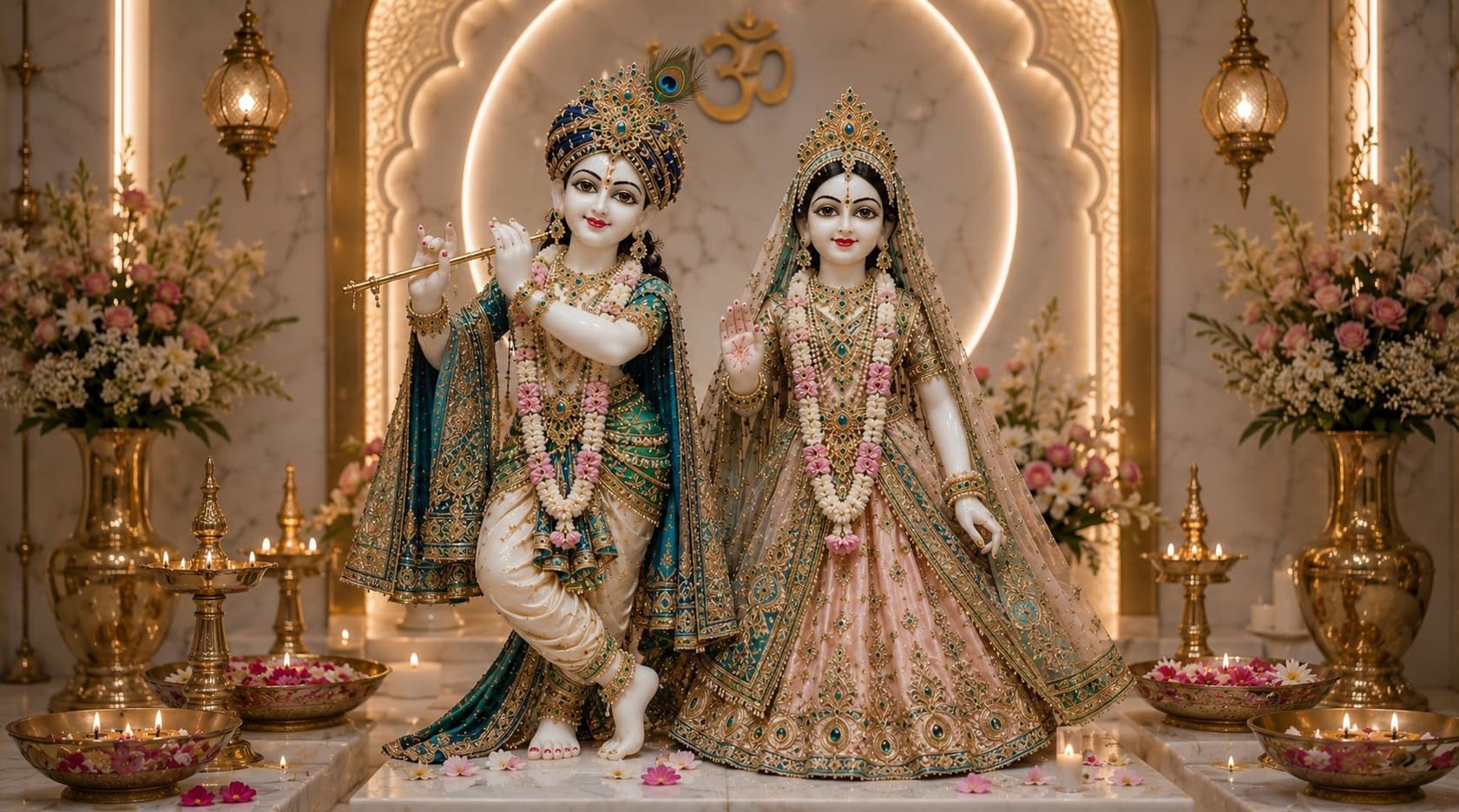 Radha Ashtami 2026 — How to Dress Radha Rani Ji and Laddu Gopal for a Beautiful Yugal Jodi Shringar
Janmashtami celebrates Kanha Ji's arrival.
Radha Ashtami, traditionally observed fifteen days later, celebrates Hers.
And in many Vaishnava households, Radha Ashtami carries a quality of devotion that is distinct from Janmashtami, quieter, perhaps, but in some ways even more intimate. Because on this day, the entire shringar is centered on Radha Rani Ji. In many homes and devotional traditions, Her poshak, abhishek, and darshan receive special attention.
Kanha Ji, on Radha Ashtami, is present, but in service of the celebration of Her.
For households with a Yugal Jodi or Kanhaji Darbar setup, this changes the shringar logic entirely. This guide covers everything you need to create a beautiful, meaningful Radha Ashtami Yugal Jodi shringar at home on Saturday, September 19, 2026.
This guide is written with reference to Radha Ashtami shringar traditions observed in Barsana, Vrindavan, and Mathura, where Radha Rani Ji's appearance day is celebrated with particular devotion. Last updated August 2026.
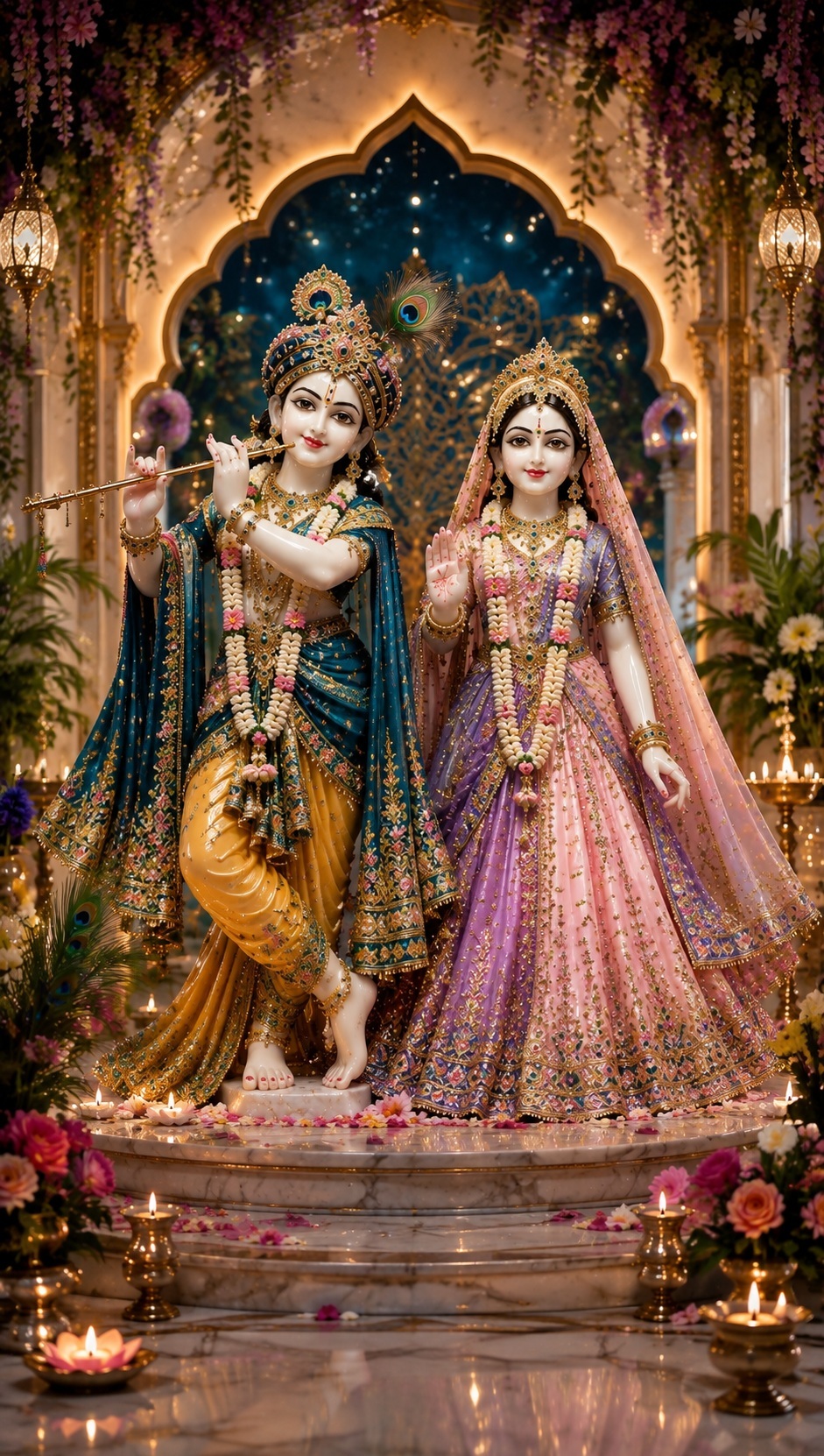
Quick Answer: On Radha Ashtami, Radha Rani Ji is the focal point of the shringar. Choose Her poshak first, then coordinate Kanha Ji's dress, mukut, jewellery, and colours around Her presentation. For a Yugal Jodi, both figures should feel visually connected, while Radha Rani Ji remains the centre of the darshan.
What is Radha Ashtami and when is it in 2026?
Radha Ashtami is the appearance day of Shri Radha Rani Ji, celebrated on the Ashtami Tithi of Shukla Paksha in the month of Bhadrapada, traditionally observed fifteen days after Janmashtami. In 2026, Radha Ashtami falls on Saturday, September 19. The Ashtami Tithi spans September 18–19, 2026; exact start and end times vary by location, so devotees should confirm the precise timing via their local Panchang.
In Barsana, Radha Rani Ji's birthplace, the day is celebrated with a grandeur that rivals any other Vaishnava festival. Temples in Vrindavan and Mathura observe special darshans and flower decorations. For home devotees across Delhi, UP, Rajasthan, and beyond, Radha Ashtami is becoming an increasingly observed occasion for a full, thoughtful home shringar.
Quick Reference, Radha Ashtami 2026
- Date: Saturday, September 19, 2026
- Ashtami Tithi: Spans September 18–19 (verify exact times via your local Panchang)
- Madhyahna Kaal: Midday window on September 19, check local Panchang for your city
- Focal deity: Radha Rani Ji, Her shringar is primary
- Best poshak for Radha Rani Ji: Handcrafted Radha Rani lehenga or Radha Rani heavy poshak
- Kanha Ji's poshak: Chosen second, in a complementary color
Why Radha Ashtami Shringar Is Different From Janmashtami
On Janmashtami, devotees naturally center all preparation on Kanha Ji. His poshak is chosen first, His mukut is matched to it, His accessories are laid out. Radha Rani Ji, when present, complements Him.
On Radha Ashtami, the focus shifts toward Radha Rani Ji.
Radha Rani Ji is the focus of the occasion. Many households that give great attention to Kanha Ji's Janmashtami poshak find themselves pausing on Radha Ashtami and asking: have we ever given Radha Rani Ji's shringar the same quality of thought?
This is the soul of Radha Ashtami preparation. It is not just about buying a poshak. It is about consciously directing attention toward Her, with the same care and intentionality that makes Janmashtami shringar what it is.
Janmashtami vs. Radha Ashtami, Shringar Comparison
| Feature | Janmashtami | Radha Ashtami |
|---|---|---|
| Festival focus | Kanha Ji | Radha Rani Ji |
| Main shringar decision | Kanha Ji's poshak | Radha Rani Ji's poshak |
| Yugal Jodi darshan | Krishna-led | Radha-led |
| Colour coordination order | Kanha Ji first | Radha Rani Ji first |
| Mukut priority | Kanha Ji's mukut | Radha Rani Ji's mukut |
For the underlying principles of coordinating a Yugal Jodi shringar, the color logic, fabric coordination, and visual balance that makes both figures feel like a unified pair, our complete Radha Krishna dress guide for Yugal Jodi covers all of that in full detail. Everything in that guide applies to Radha Ashtami, with the single shift that Radha Rani Ji leads.
"On Radha Ashtami, the darshan is Hers. The poshak you choose for Radha Rani Ji on this day is the offering that matters most."
The Madhyahna Shringar, An Important Part of Radha Ashtami Seva
In major temples of Vrindavan, Mathura, and Barsana, Radha Ashtami is marked by a special noontime shringar, the Madhyahna shringar, performed during the auspicious midday window. In Vrindavan's major temples, this darshan draws devotees from across the country.
For home devotees, this is the ideal time to complete Radha Rani Ji's full Radha Ashtami shringar, the new poshak, the abhishek, the fresh flowers, the bhog offering. Not because the rest of the day is inauspicious, but because the midday timing carries a particular significance in the tradition, making it a meaningful time for the celebration.
Practically speaking: begin preparation in the morning. Source fresh flowers early, the morning market has the freshest selection. Have everything ready so that when the Madhyahna window opens, the shringar can begin immediately, unhurried.
Choosing the Right Radha Rani Ji Poshak for Radha Ashtami
This is the most important decision of the entire Radha Ashtami preparation, and it should be made first, before thinking about Kanha Ji's poshak at all.
A Styling Framework for Radha Rani Ji's Sacred Colors
The most traditionally resonant colors for Radha Rani Ji on Her appearance day are those associated with Her in devotional tradition, soft pinks, luminous gold tones, and ivory. Each creates a distinct quality in the darshan:
- Deep rose pink: The most festive and visually rich choice. Works beautifully with gold-tone zari embroidery. Pairs naturally with Kanha Ji in soft saffron or coral.
- Pale gold: Creates a soft, luminous appearance, elegant rather than bold. Pairs naturally with yellow or saffron tones for Kanha Ji.
- Ivory and gold: A regal, understated choice for devotees who prefer a more classical presentation. Pairs beautifully with Kanha Ji in peacock blue or deep saffron.
- Saffron: A warm, sacred tone that honors the devotional spirit of the day. Pairs naturally with midnight blue or ivory for Kanha Ji.
Poshak Styles for Radha Ashtami
- Handcrafted Radha Rani Lehenga: A particularly beautiful choice for a special occasion of this significance. A handcrafted Radha Rani lehenga in heavy silk or Banarasi with original hand embroidery offers the same quality of craftsmanship that a premium Kanha Ji poshak carries on Janmashtami. This is Her appearance day, the poshak should honor that.
- Radha Rani Heavy Poshak: An equally meaningful choice, slightly less structured than a lehenga but equally rich in fabric weight and embellishment. More widely accessible while still appropriate for Radha Ashtami.
- Traditional Radha Rani Chunri and Chandrika: For devotees who observe the traditional style of Radha Rani Ji's shringar, the chunri with chandrika creates a classical, graceful appearance that is deeply rooted in Vaishnava tradition. Appropriate as long as the fabric is not too light for the occasion.
The governing principle for fabric coordination is straightforward: both figures should feel like they belong to the same occasion in terms of weight and elaborateness. A heavy embroidered Radha Rani poshak paired with a plain Kanha Ji dress creates an imbalance that is obvious even in photographs.
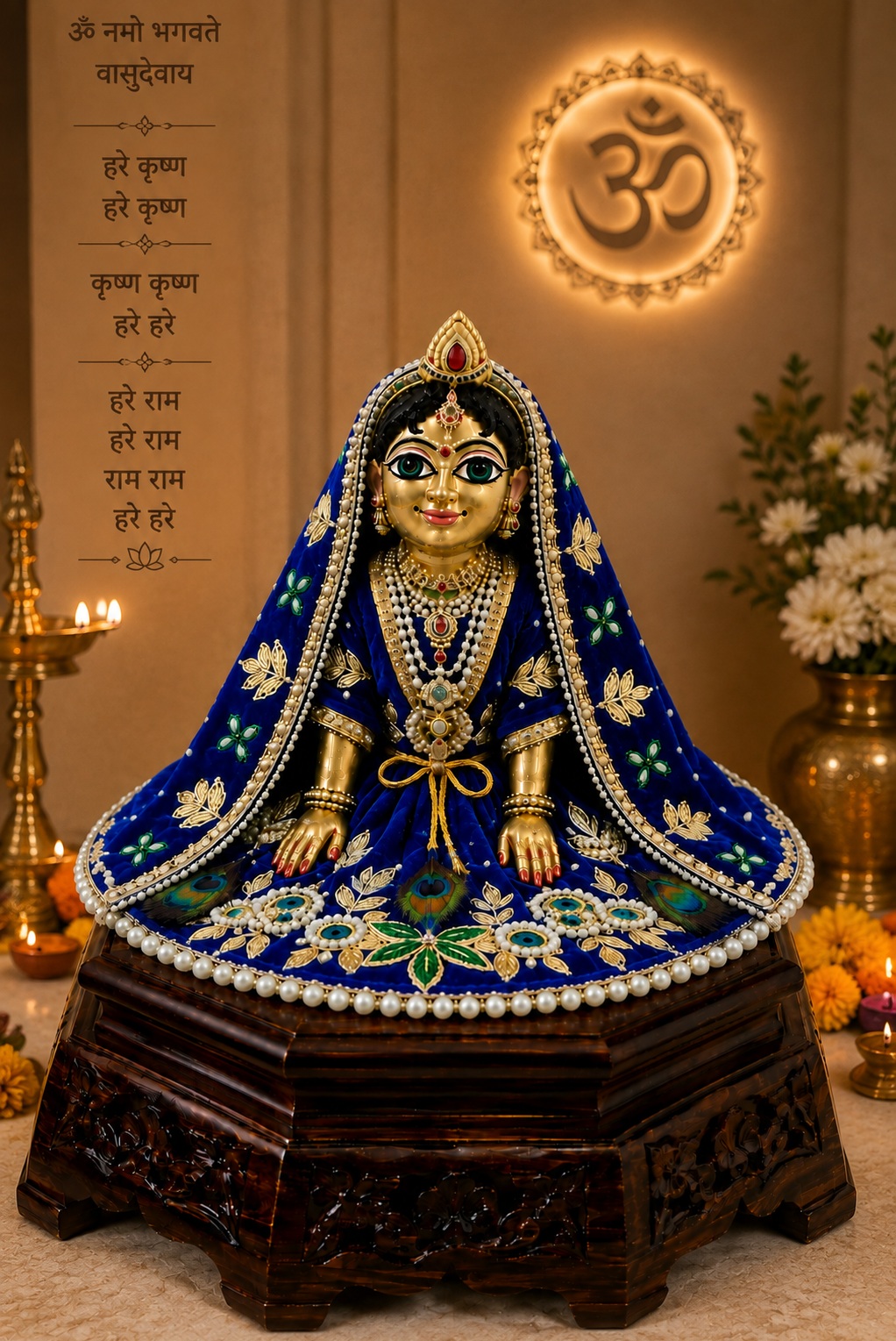
How Divyambar Designs for Yugal Jodi
At Divyambar, Yugal Jodi dressing is approached as a unified pair rather than two unrelated garments. Color palettes, zardozi embroidery density, handcrafted silk brocade borders, and fabric textures are considered together so Radha Rani Ji remains the visual focus while Kanha Ji complements the overall darshan. This ensures visual harmony that scales perfectly, whether styling a large mandir setup or a smaller home darbar.
Kanha Ji's Poshak on Radha Ashtami, Complementing Her
In a Yugal Jodi darshan, the pair is the subject. And on Radha Ashtami, Radha Rani Ji is the heart of that pair.
Kanha Ji's poshak should:
- Have a similar level of visual richness so both figures feel balanced as a pair.
- Complement Her color, not match it identically, and not compete with it.
- Remain visually supportive rather than becoming more elaborate than Her poshak.
Complementary pairings for Radha Ashtami:
| Radha Rani Ji Poshak Color | Kanha Ji Poshak Color |
|---|---|
| Deep rose pink | Soft saffron or coral |
| Pale gold | Deep yellow pitambar |
| Ivory / white | Peacock blue or soft gold |
| Saffron | Midnight blue or ivory |
The deep yellow pitambar Laddu Gopal dress, or a Kanha Ji poshak in midnight blue, are both natural complements to Radha Rani Ji's rose or ivory poshak. A Janmashtami-quality poshak for Kanha Ji remains appropriate here; the coordination principle simply shifts, Her poshak leads, His follows.
One practical note on sizing: the two figures in a Yugal Jodi setup may well be different sizes, so each should be measured separately. Our Laddu Gopal poshak size chart covers the measurement process for both figures.
Mukut and Accessories for Radha Ashtami Yugal Jodi
The mukut, for both Radha Rani Ji and Kanha Ji, is the element that elevates a well-chosen poshak into a truly complete darshan. On an occasion as significant as Radha Ashtami, the accessories should match the care of the poshak.
For Radha Rani Ji: A floral-style or chandrika mukut in a gold tone can create a particularly graceful traditional look for Radha Rani Ji. On Her appearance day, a mukut that references Her association with flowers and gardens carries its own devotional resonance. If you observe the chandrika style as part of Her traditional shringar, Radha Ashtami is a fitting day to use your finest one.
For Kanha Ji: A mor pankh mukut, featuring the peacock feather, is among the most theologically meaningful options for Krishna's shringar on any occasion. A gold-tone stone-work mukut is the most versatile alternative. For a visually coordinated Yugal Jodi, keeping both mukuts in the same metal tone usually creates the most harmonious result, mixing gold-tone and silver-tone across the same setup can create a visual inconsistency that affects the overall darshan.
For complete guidance on choosing, sizing, and matching a mukut for Kanha Ji, including how to ensure stability and which styles pair with which poshak types, our complete mukut guide for Laddu Gopal and Kanha Ji covers every element in detail.
For a complete accessories checklist, jewellery set, haar, kamarbandh, payal, and bansuri, that applies equally to Radha Ashtami, the Janmashtami shringar accessories guide covers each element. The same accessory completeness that makes Janmashtami darshan feel whole applies here, on Radha Ashtami, Radha Rani Ji's accessories deserve that same layering of attention.
The Complete Radha Ashtami Shringar Sequence
Morning (Sunrise to 11:00 AM)
Begin with a gentle snaan (bath) for both Radha Rani Ji and Kanha Ji. Fresh flowers should be sourced early, the morning market has the freshest selection. Prepare the poshak, mukut, and accessories before the Madhyahna window begins. If you are creating a Phool Bangla decoration alongside the poshak shringar, source all flower materials now, they need to be arranged close to the puja time to stay fresh.
Madhyahna Worship Window
This is the primary shringar window. Dress Radha Rani Ji in Her Radha Ashtami poshak first, taking full care with each element. The mukut placed on Her head should complement Kanha Ji's in metal tone and style.
Dress Kanha Ji second, in a poshak chosen to complement Radha Rani Ji. Place His bansuri last. Step back and observe the Yugal Jodi darshan together before lighting the diya.
For the daily routine elements of shringar, the snaan, the bhog sequence, the flower placement, our daily shringar guide for Laddu Gopal covers the baseline seva that informs even festival preparation.
Aarti and Bhog
Offer bhog during the Madhyahna window, milk, mishri, seasonal fruits, and sweets are traditional for Radha Ashtami. The bhog is offered to both Radha Rani Ji and Kanha Ji together, but the prayer is primarily directed to Her on this day.
Flowers for Radha Ashtami, Choosing Flowers for Seva
Flowers hold even greater significance on Radha Ashtami than on most other occasions, because Radha Rani Ji is so deeply associated with the gardens and forests of Vrindavan in devotional tradition, and because fresh flowers carry the quality of impermanence that makes them a uniquely personal offering.
- White champa (plumeria): Often associated with devotional flower offerings in Braj. Where available, even a few champa flowers in Radha Rani Ji's shringar add a fragrance dimension that no other flower can replicate.
- White jasmine: A classic choice for Radha Rani Ji's shringar. Jasmine haar placed around the singhasan and woven into the flower arrangement creates both fragrance and visual beauty.
- Rose: Deep pink or coral roses for Radha Rani Ji; yellow or orange for Kanha Ji. A complementary flower arrangement mirrors the poshak color coordination, and the effect, when done thoughtfully, is genuinely beautiful.
- Lotus: Where available, lotus petals carry obvious significance for this devotional context.
A Phool Bangla arrangement, fresh flowers creating a bower around the entire Yugal Jodi singhasan, is a well-known floral seva tradition associated with Braj and Vrindavan, and one of the most beautiful ways to observe Radha Ashtami at home. Our complete Phool Bangla guide covers how to create this at home in full detail, which flowers to use, how to build the canopy and singhasan decoration, and how to time the preparation so the flowers are fresh at the moment of puja.
For Radha Ashtami specifically, the Phool Bangla for Yugal Jodi carries particular resonance: Radha Rani Ji in white flowers, Kanha Ji in yellow and orange, within the same decorated singhasan, is among the most evocative presentations possible on Her appearance day.
Ordering for Radha Ashtami, Timeline and What to Avoid
Radha Ashtami falls traditionally fifteen days after Janmashtami, which means it arrives quickly. Many devotees who ordered a Kanha Ji poshak for Janmashtami did not simultaneously think about Radha Rani Ji's Radha Ashtami poshak. And then Janmashtami passes, the festival energy settles, and Radha Ashtami is suddenly close.
For handcrafted or made-to-order poshaks, ordering at least 1–2 weeks before Radha Ashtami gives you a safer buffer for delivery, size checks, and exchanges.
The most common practical mistake is ordering both poshaks in the same size without measuring each figure separately. Since the two figures in a Yugal Jodi setup may be different sizes, a single matched size will almost always leave one figure poorly fitted. Measure each separately, our Laddu Gopal poshak size chart explains the process in a minute.
Divyambar's Seva Insight On Radha Ashtami, the most meaningful thing a devotee can do is to simply pause, to consciously think about Radha Rani Ji's shringar with the same attention they give to Kanha Ji on Janmashtami. Not because the poshak must be more expensive, but because the quality of attention offered is the real offering. The poshak you choose carries the attention behind it.
When preparing for Radha Ashtami, finding the right poshak for Kanha Ji to complement Radha Rani Ji's darshan is the final coordination step. Our Laddu Gopal dress collection has handcrafted poshak options sized precisely and designed with the quality that Radha Rani Ji's appearance day deserves. For dedicated pieces designed exclusively for Her, explore our Radha Rani poshak collection to complete the Yugal Jodi.
Frequently Asked Questions
When is Radha Ashtami in 2026?
Radha Ashtami 2026 falls on Saturday, September 19. The Ashtami Tithi spans September 18–19, 2026; exact start and end times vary by location, so devotees should check their local Panchang. The Madhyahna worship window falls during the midday hours of September 19.
What is the best poshak for Radha Rani Ji on Radha Ashtami?
A handcrafted Radha Rani lehenga or Radha Rani heavy poshak in deep rose pink, pale gold, or ivory is an appropriate choice for Radha Ashtami. The quality of the Radha Rani poshak should reflect the significance of Her appearance day, ideally in a fabric and embellishment level that mirrors what you would choose for Kanha Ji on Janmashtami.
What should Laddu Gopal wear on Radha Ashtami?
Kanha Ji should wear a fresh poshak that complements Radha Rani Ji's color and matches Her fabric weight. Since She is the focal deity on this day, His poshak should be equally rich, but chosen to support Her shringar rather than overshadow it. The color table in the Kanha Ji section above covers the most natural pairings.
Which flowers are good for Radha Rani Ji's Radha Ashtami shringar?
White champa, white jasmine, deep pink roses, and lotus petals are all appropriate where available. A Phool Bangla arrangement, flowers creating a bower around the Yugal Jodi singhasan, is one of the most beautiful ways to observe Radha Ashtami at home. See our complete Phool Bangla guide for step-by-step instructions.
How is Radha Ashtami different from Janmashtami in shringar terms?
On Janmashtami, Kanha Ji is the focal deity and His poshak is the primary shringar decision. On Radha Ashtami, Radha Rani Ji is the focal deity, Her poshak is chosen first, Her shringar receives the most attention, and Kanha Ji's poshak is selected to complement Her. The Yugal Jodi darshan on Radha Ashtami is centered on Radha Rani Ji.
What is the Madhyahna shringar on Radha Ashtami?
The Madhyahna shringar is the primary noontime worship ritual observed on Radha Ashtami, during which Radha Rani Ji receives Her special poshak, abhishek, and bhog offering. Observed in Vrindavan, Mathura, and Barsana temples, this midday window is widely observed as a particularly significant time to complete the full Radha Ashtami shringar at home.
How do I coordinate mukut for the Yugal Jodi on Radha Ashtami?
For a visually harmonious Yugal Jodi, keeping both mukuts in the same metal tone usually gives the most settled result. A floral chandrika mukut for Radha Rani Ji paired with a mor pankh mukut for Kanha Ji is a particularly resonant Radha Ashtami combination. For complete mukut guidance including sizing and stability, see our mukut guide for Laddu Gopal and Kanha Ji.
How do I size poshak for a Yugal Jodi Radha Ashtami setup?
Measure both Radha Rani Ji and Kanha Ji separately, each measured in inches from feet to head, not including the mukut. The two figures in a Yugal Jodi may well be different sizes, so a single "matched set" ordered in one size will rarely fit both correctly. Our Laddu Gopal poshak size chart covers the measurement process and the Radha Rani pairing section in full.